

A Marathon Record Bites the Dust
Sebastian Sawe ran 26.2 miles in under two hours, joining the ranks of those who achieved what others thought impossible.

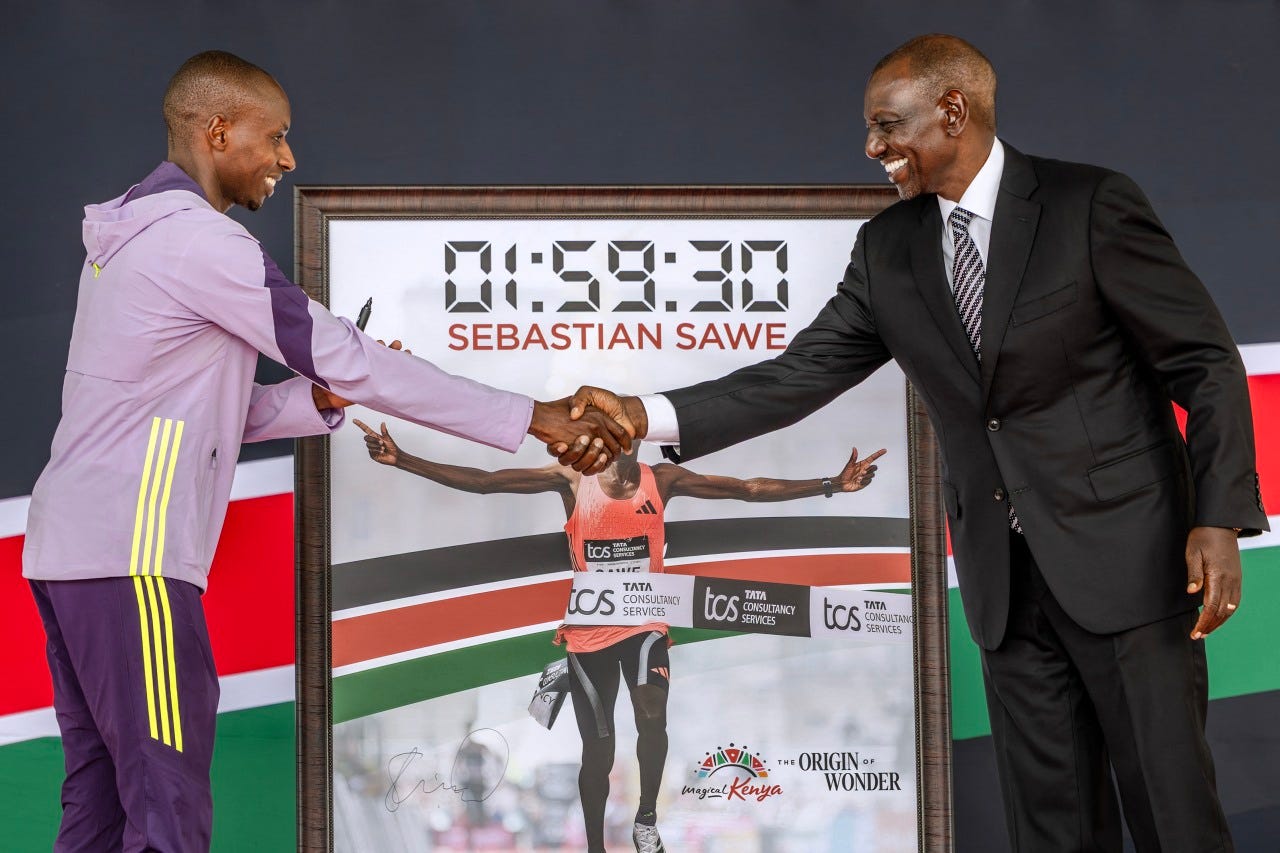
When Kenyan runner Sabastian Sawe crossed the finish line at Sunday’s London Marathon, he instantly became a running legend. Not that he was a slouch before. Some of his earlier times were among the fastest ever: 2 hours and 2 minutes in Valencia, Spain, in 2024 and in Berlin and London last year.
For all that, he still had that stubborn 2 as the first digit in his time. Some had speculated that a sub-2-hour marathon was possible. Sports journalist Alex Hutchinson predicted it would happen—in 2075. Unofficially, Eliud Kipchoge did it in the race equivalent of laboratory conditions—aided by pacemakers, not in open competition, with hydration delivered by bicycle—so it didn’t count. However close to breaking the 2-hour threshold he and others had come, the record’s persistence kept him and others in the realm of mere, if impressive, humanity. Why, even a humble marathoner like me has a marathon best with a 2 in it—even if I had to add another half-hour atop Mr. Sawe’s far superior times.
Until Sunday. That’s when he finished the London Marathon in 1 hour, 59 minutes and 30 seconds. In doing so, he shattered another one of those barriers that so often seem to set some limit on human accomplishment. Until someone decides to prove that they don’t.
Mr. Sawe places himself in a noble tradition, one connected with the London Marathon itself. The race was co-founded in 1981 by John Disely and Chris Brasher. Brasher deserves more renown outside running circles. If you don’t know him, you might know Roger Bannister. On May 6, 1954, Bannister became the first person to run a mile in under 4 minutes. Brasher paced him for the first two laps of this feat.
A sub-4 mile remains difficult. I’ve never come close and almost certainly never will. People once thought it, too, was an unbreakable barrier. “Most of the commentators told him he couldn’t possibly do it,” said Sebastian Coe, a multiple Olympic medalist British runner, in the 2016 documentary “Bannister: Everest on the Track.” An AP headline from the time read: “Coach Says 4 Minute Mile and 9 Seconds ‘100’ Are Humanly Impossible.” Some worried that even attempting might be dangerous.
That didn’t stop Bannister. Then working as a doctor, he simply didn’t see any physiological basis for the difference between running a mile in 4 minutes and 1 second and doing it in 3 minutes and 59 seconds. He proved there wasn’t one. And less than two months later, Australian John Landy, who had been edging close to the barrier around the same time, broke it even more decisively than Bannister had, proving Bannister wasn’t some one-off freak of nature.
Bannister saw himself in a tradition of human—and specifically Anglospheric—accomplishment. About a year before his sub-4, New Zealander Edmund Hillary and his sherpa Tenzing Norgay became the first people confirmed to have summited Mt. Everest. That was another thing thought impossible, dangerous even to try. Bannister found “great inspiration” from the successful climb and believed his race and it were “linked.”
He’s right. Those achievers belong in the same category. That now very much includes Mr. Sawe. It also includes Ethiopian Yomif Kejelcha, who finished 11 seconds after Mr. Sawe. Mr. Kejelcha, running his first marathon, deserves far more than a place in running history as the Michael Collins of the sub-2. Collins was the astronaut who stayed in the Apollo 11 module while Neil Armstrong and Buzz Aldrin walked on the lunar surface—another thing thought impossible.
Since Mr. Sawe’s marathon milestone, some have started to ask how he did it. Before the race, he went out of his way to establish he wasn’t doping. “Is It the Shoes?” asked the headline of Mr. Hutchinson’s assessment. The Journal’s Jason Gay focused on improvements in nutritional science. Both surely helped. But the best shoes and the best food in the world can’t get you all the way there. For that, you need in spades one of the best attributes of the human race: an unconquerable drive to prove that what others think is impossible . . . isn’t.
Mr. Butler is deputy editor of Free Expression.