

America Needs the Filibuster
Partisans warn of doom if their agenda isn’t enacted, but their expedient is what threatens the republic.
By Ben Sasse
Free Expression is a daily newsletter on American life, politics and culture from the Opinion pages of The Wall Street Journal. Sign up and start reading Free Expression today.
Americans are addicted to apocalypse porn. Politicians on both sides warn that the world will end unless American life is immediately reordered around a particular set of policy proposals. The questions change, but the answer is always the same: To prevent American carnage or to defend democracy from darkness, power must be consolidated—right now.
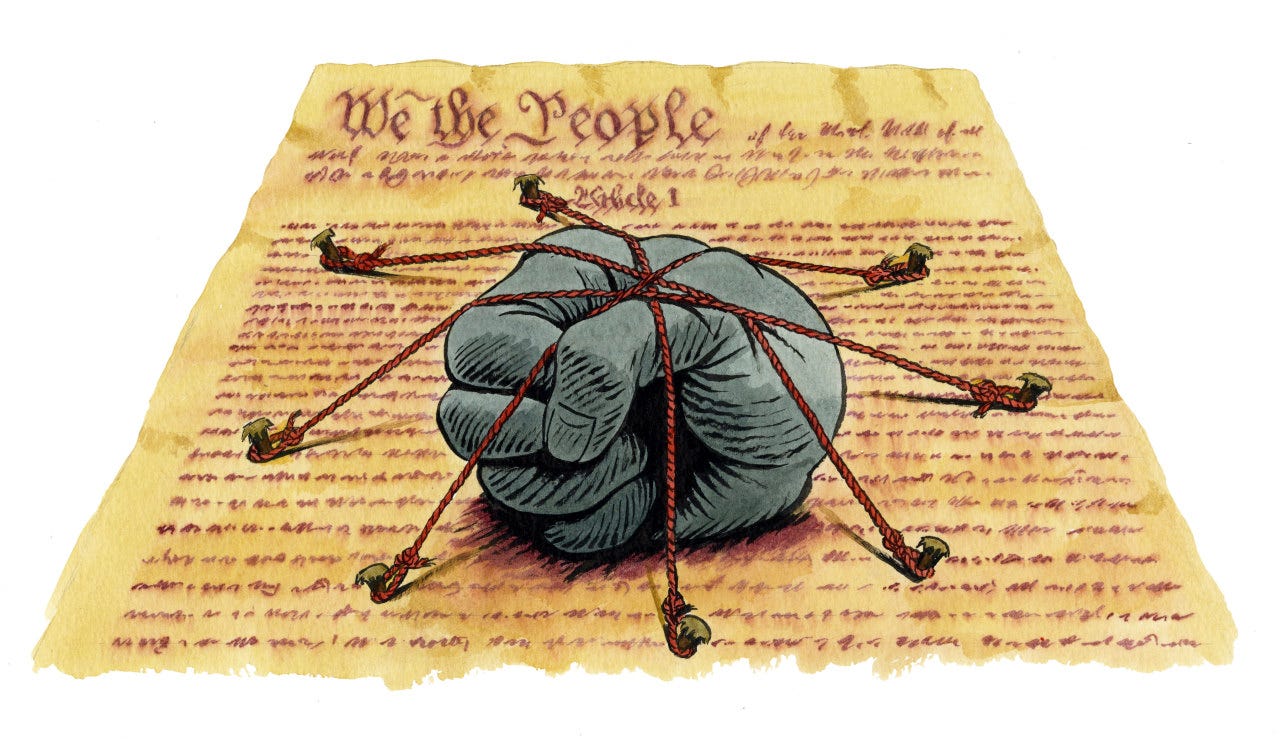
These warnings cause a cortisol spike in the body politic and fry the nation’s nervous system, exhausting the citizenry. The Constitution begins from a different place: extreme skepticism of consolidated power. Additionally, in the Senate, the filibuster requires 60 votes to pass most legislation. This provides a bulwark against consolidated power. Preserving this tradition is a prerequisite for national recovery and endurance.
Americans divide power again and again because we don’t want it at the center of life. We distinguish between the private and public sectors. We privilege the private sector because it’s pluralistic and persuasion-based. In the public sector, we divide power among local, state and federal governments, deferring jurisdiction over most topics to the elected officials closest to the people. We do this for the sake of accountability, experimentation and comparison, and to limit the possibility of cascading failures.
Articles I, II and III of the Constitution divide power among three federal branches: legislative, executive and judicial. Each branch checks the others, but the Founders put the most authority in legislative hands. As a result, we divide lawmaking power yet again, between two very different bodies. We put the House and Senate on different time horizons and give them different constituencies.
The upper house is built for the long view, with six-year terms that encourage a deliberative trustee model of representation. Senators owe their states both judgment and conscience. The House provides faster-loop warnings about public frustrations. Two-year terms and smaller districts combine to encourage a more urgent, passionate delegate model of representation.
Despite these differences, enacting a federal law requires navigating both complex institutions in the same 24-month window and also giving the president an opportunity to weigh in. It’s a long shot by design. We do this in part to give the public time to come aboard—or to object angrily. We also do it because civic life works better when one-size-fits-all nationwide laws come with buy-in from large cross-sections of this continental republic.
That’s American Constitutionalism 101. While the Senate’s filibuster rule isn’t in the text of the most glorious political document ever written, it plays a critical role in limiting and dividing power. Via procedural requirements to secure a supermajority of 60 votes before legislation can be passed, the filibuster safeguards the spirit of the Constitution’s anticonsolidation objective and prevents the misery of never-ending Flight 93 elections.
When partisans talk about killing or “reforming” the filibuster, they’re saying they want to turn the Senate into another House of Representatives. That would be a tragic mistake. The filibuster prevents the dramatic pendulum swings that are the natural result of simple-majority lawmaking. Every election and every vote becomes an existential crisis in a system that no longer plods through checks and balances but instead rushes to European-style referenda.
It’s a partisan’s dream: Court packing, new states, federal takeover of state elections, national adoption of Utah’s gun laws or New York’s abortion laws. Sweeping changes to nearly every aspect of national and local life.
Voters might love or hate this or that policy outcome. Senators can love or hate the supermajority requirement—there are plenty of politicians who have shamelessly taken both sides of the filibuster debate depending on whether their party possesses or anticipates a Senate majority. But all of us should recognize the danger that a faster, less-constrained government will chip away at the American creed.
Neither zealous constitutionalism nor deep skepticism of consolidated power should be narrowly associated with the political right. But unfortunately in recent decades, the progressive left has gone further in jettisoning our foundational ideas about limited federal government. This is sad but perhaps predictable. What wasn’t predictable was that some on the right would fall in love with permanent power politics.
The partisans who decry the filibuster always say, “The stakes are too high and we’ve got to do it for X.” Then there’s this: “The other guys are going to do it themselves, so let’s do it first.” The reality is that once the dam breaks, the stakes will climb endlessly higher. For every X on the right, there’s a Y on the left. Without the filibuster, we’ll have a never-ending cascade of doom-peddlers telling Americans our best days are behind us unless we secure 51 immediate votes for their golden legislative ticket.
There remains a chance for national recovery. It will evaporate if the right succumbs fully to the temptation of the one-way ratchet of consolidated power.
America’s public square needs a recovery. That depends on regular folks showing up, affirming a “one cheer for politics” ethos, rolling their eyes at jeremiads, laughing at apocalypse pornographers, and gratefully celebrating 250 years and counting. All of these become less likely if we foolishly eliminate the filibuster.
Mr. Sasse is a Free Expression columnist at WSJ Opinion. He served as a U.S. senator from Nebraska, 2015-23.
Thank you for this.