

America’s Posterity Problem
The decline in national pride and patriotism among Gen Z is a warning.

Free Expression is a daily newsletter on American life, politics and culture from the Opinion pages of The Wall Street Journal. Sign up and start reading Free Expression today.
I hope Freddy stays in America long enough to visit a classroom. Freddy—his last name is unknown—is a German soccer fan whose account of his trip to the U.S. for the World Cup has gone viral on social media. He’s one of many foreign visitors this summer who have marveled online at America’s size, beauty, prosperity and hospitality. They’ve given the country a boost on the eve of its 250th birthday.
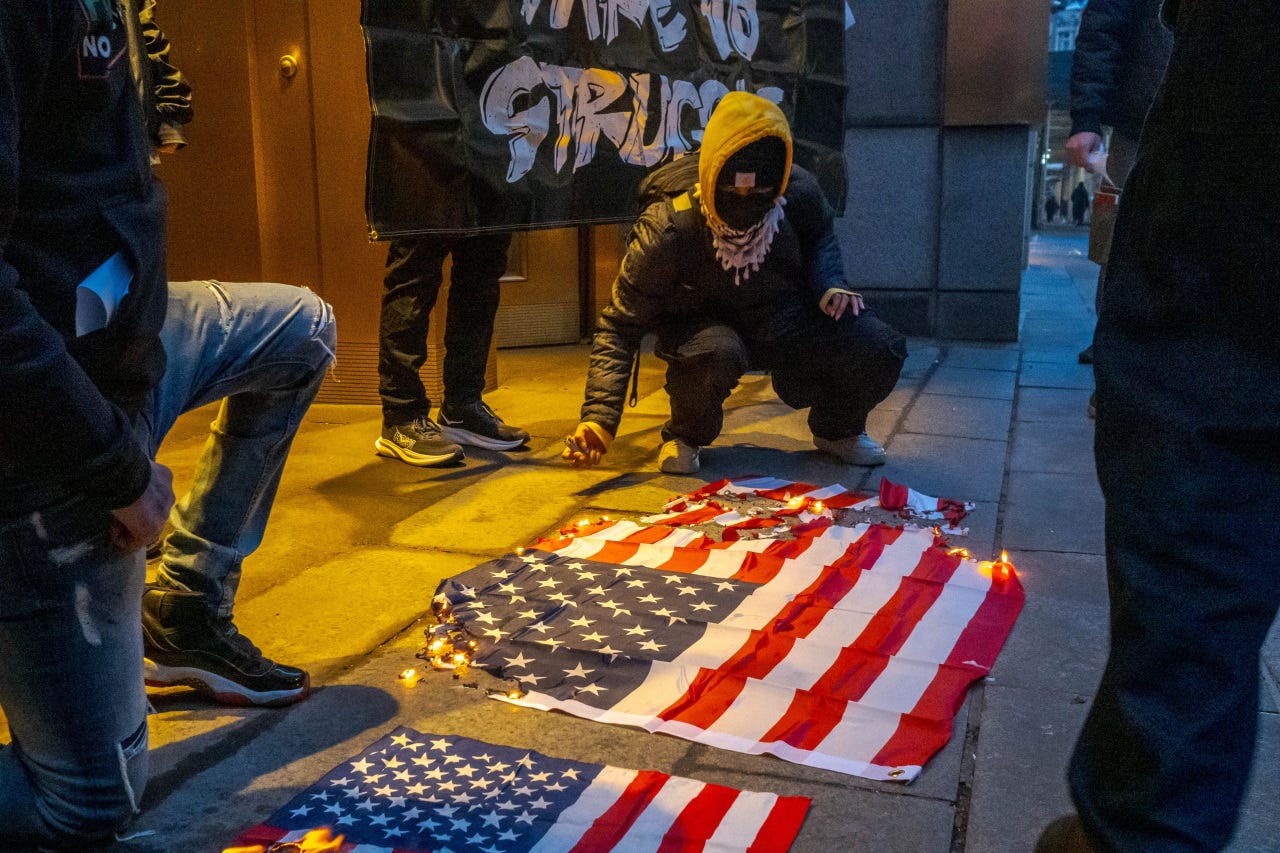
College students need to hear from people like Freddy. They need to hear what makes America great. Public opinion data show a decline in national pride and patriotism, especially among 18- to 29-year-olds. The numbers are a warning.
If the rising generation—known as Gen Z—embraces a culture of ingratitude and rejection, American exceptionalism will fade into history. Socialism and antisemitism will march to the fore. Political violence will be normalized. The national motto will change from “E Pluribus Unum” to “LOL Nothing Matters.” No one should want to inhabit such a future.
A new report from my American Enterprise Institute colleagues Karlyn Bowman and Nicole Penn highlights the problem. “America at 250: Surveying Change and Continuity on Civic Values” updates a 1998 Public Agenda Foundation survey on civic education and patriotism. Ms. Bowman and Ms. Penn found that most Americans understand the importance of our nation’s founding and tradition of freedom. Most Americans say that schools should help students become good citizens. They agree that America is a unique country that stands for something special.
But Gen Z stands apart. While 35% of baby boomers in the AEI survey said they had read the Declaration of Independence in full, only 23% of Gen Z had. While 91% of baby boomers could explain the meaning of the Fourth of July, 77% of Gen Z could do the same. Gen Z placed a lesser importance on acquiring basic academic skills, developing social skills and teaching civic education. Overall, 65% of Americans said the U.S. is a nation unlike any other. Among Gen Z, the number fell to 52%.
These results aren’t novel. Gallup has been measuring national pride since 2001. Last year it found that the number of people who said they were extremely or very proud to be American sank to 58% from 87% in 2001. Gen Z expressed the lowest levels of patriotism: Only 41% said they were extremely or very proud to be American. And partisanship worsens such attitudes. “Notably, more Gen Z Democrats say they have little or no pride in being an American (32%) than say they are extremely or very proud,” wrote pollster Jeffrey M. Jones.
That’s how you get Zohran Mamdani. The question is why.
Begin with the institutions that build character. Where does Gen Z go for answers to life’s questions? Families, churches and schools are the traditional guides for young people. Today they’re weak.
In 1960, 88% of children lived with two parents. By contrast, a little more than two-thirds of Gen Z was raised in a two-parent household. A stable family structure is vital to a child’s growth. But what happens when parents bring up children according to a script of secularism, apathy and nonjudgment?
According to the Pew Research Center, Gen Z has the lowest levels of religious identification and daily prayer among Americans. It’s the generation least likely to say that religion is important. It’s also the least Christian.
AEI’s Ms. Bowman and Ms. Penn found that today’s parents are relatively blasé about what goes on inside classrooms. Compared with parents in 1998, today’s moms and dads are less judgmental. They’re less likely to be upset if a teacher fixates on America’s faults.
It shows. Public school have relaxed their standards. Course materials favor social justice and diversity. SAT scores have plummeted. The National Assessment of Educational Progress has found a similar downward trend.
Without guidance from parents, pastors and teachers, students will emulate celebrities and entertainers, thinkers and entrepreneurs. Loud voices fill the space tradition leaves behind. “What rules the world is ideas,” Irving Kristol wrote in 1975, “because ideas define the way reality is perceived; and, in the absence of religion, it is out of culture—pictures, poems, songs, philosophy—that these ideas are born.”
The mass culture of Kristol’s time is no more. Fractured subcultures of streamers, podcasters, social-media channels, Instagram and TikTok influencers and memelords shape the way that Gen Z sees the world—with unsettling effects.
These digital natives grew up with social media that amplifies conspiracy theories, erodes confidence in authority and serves as platforms for anti-American propaganda. Hence, Gen Z doesn’t only distrust the U.S. It distrusts everybody.
Patriotism doesn’t appear out of nowhere. It is taught. We can’t wish the 21st century away. American patriots must meet Gen Z on its terms and make the case for America’s virtues in its language, while strengthening families, churches and schools.
That’s why Freddy and his fellow travelers matter. They provide a cure for the anti-Americanism that prevails online and in the minds of too many young people. They create antibodies to heal an ailing body politic. It’s a treatment we desperately need.
Mr. Continetti is a Free Expression columnist at WSJ Opinion.
 | A guest post by
|