

Andy Burnham Is Mad for It
The conquering hero of Labour politics is bringing Manchesterism to London. Nobody knows for sure what that means.
By Dominic Green
Free Expression is a daily newsletter on American life, politics and culture from the Opinion pages of The Wall Street Journal. Sign up and start reading Free Expression today.
The U.K.’s new prime minister, Andy Burnham, didn’t win his parliamentary seat by campaigning on Labour’s 2024 general election manifesto. He won it by intrigue after its Labour incumbent, Josh Simons, stepped aside following an ethics inquiry. Nor did Mr. Burnham win Labour’s leadership by the customary method, a contended election in which the candidates set out their plans. Instead, a majority of Labour MPs acclaimed him without asking him what he proposes to do as prime minister.
Mr. Burnham will start work at 10 Downing Street on July 20 without having taken questions from the press. Instead, he took a few preselected questions on the website Reddit and gave two short speeches. His ascent broke no laws, but it reeked of procedural gamesmanship. Mr. Burnham insists he wasn’t in the Commons when Labour knifed his predecessor Keir Starmer, so his hands are clean.
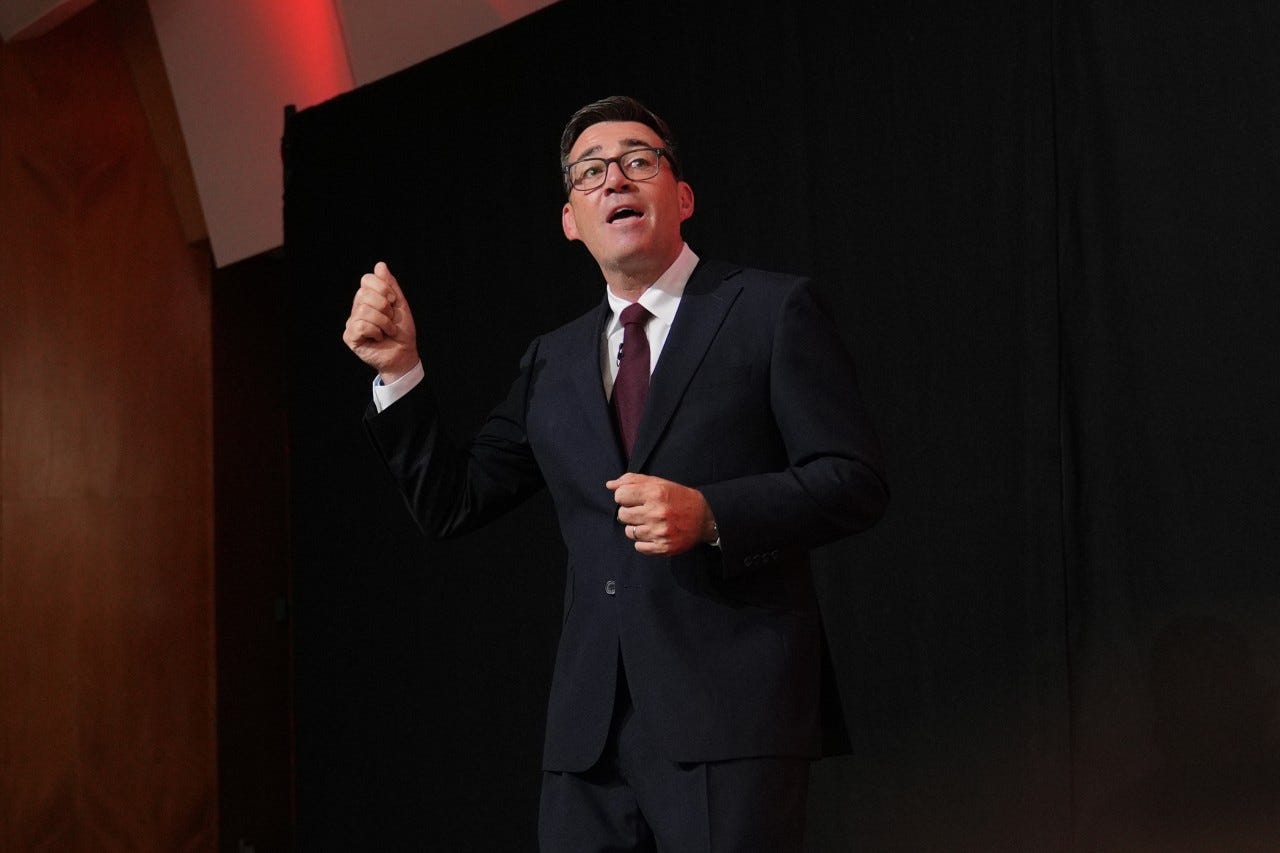
After his London speech, Mr. Burnham dad-danced to “True Faith” by the Manchester band New Order. Mr. Burnham was born in Liverpool but made Manchester his main stage. As the city’s mayor from 2017 to mid-June, he calls his tax-and-spend politics “Manchesterism.”
Manchester was once a working-class industrial powerhouse. After the mid-1970s, it reinvented itself as an indie music mecca: Buzzcocks, Joy Division and New Order, the Smiths, Happy Mondays, Stone Roses, and of course the hooligan nostalgia of Oasis, whose “Wonderwall” accompanied the England team’s traditional flameout at this summer’s World Cup. Manchester’s postindustrial musical boom made the city cool again, as a cultural counterweight to London, and laid the groundwork for the property boom that Mr. Burnham calls Manchesterism in action.
Mr. Burnham is the Mancunian Candidate. He has the “mad for it” manner of a Manchester raver from the 1990s. Where once Labour leaders talked Marx and the class war, Mr. Burnham quotes Smiths lyrics as the socialism of vibes. In 1917, when the Germans sent Lenin from Zurich to join the revolution in St. Petersburg, they prevented him from sharing his radical thoughts on the way. When Mr. Burnham crossed England’s great divide and went down to London, his words were Morrissey’s lyrics: “I left the North again, I traveled South again.” But what does this charming man really want?
The “Manchurian Candidate” of the 1962 movie is a brainwashed front for a communist conspiracy. Mr. Burnham is a performative front for socialist nostalgia. He proclaimed his election to be “the most significant change moment in our politics in 40 years.” Britain, he said, took “a series of wrong turns in the 1980s” under Margaret Thatcher. When Mr. Burnham blamed 40 years of “neoliberalism,” he indicted Tony Blair, the only Labour prime minister to match Thatcher’s three general elections wins.
Mr. Burnham outlined “a new politics” of renationalizing public utilities, redistributing spending power to regional authorities like the Labour fief he ran in Manchester, restoring the trade unions to political centrality, and reconnecting Labour to England’s “working class.” After the Thatcher revolution, the U.K. recovered as a middle-class service economy, with an abandoned underclass and, more recently, immigrants doing the dirty jobs. Manchester’s turn from the shift work of factories and mills to the consumer hedonism of Factory Records and nightclubs was part of that recovery.
Mr. Burnham’s new politics are the old politics that broke Britain in the 1970s, the lost decade of tax hikes, strikes, social decay, political extremism and a brain drain of talent. How will Mr. Burnham create his class-war time machine? By subsidizing reopened coal mines and shipyards under government management? Nationalizing British Airways (owned by an Anglo-Spanish conglomerate whose largest shareholder is state-owned Qatar Airways)? Seizing Heathrow airport from its French, Qatari, Saudi, Singaporean, Australian and Chinese proprietors?
If Britain faces ’70s-style problems today, it isn’t because of “neoliberalism.” It’s because both Labour and Conservative governments reversed the Thatcher revolution by returning to high regulation and taxation, low productivity and social mobility, and debt-financed welfarism. There’s a certain ratio between taxation, growth and government debt beyond which an economy cannot be stretched. Britain is already there. Mr. Burnham calls himself “pro-business,” but he has also hinted at further tax rises. The true faith of Labour’s socialist left always rejects both history and reality.
Mr. Green is a Journal contributor and a fellow of the Royal Historical Society.