

Art for Communism’s Sake
Frida Kahlo was an unapologetic booster of some of history’s greatest monsters.

By John J. Miller
Free Expression is a daily newsletter on American life, politics and culture from the Opinion pages of The Wall Street Journal. Sign up and start reading Free Expression today.
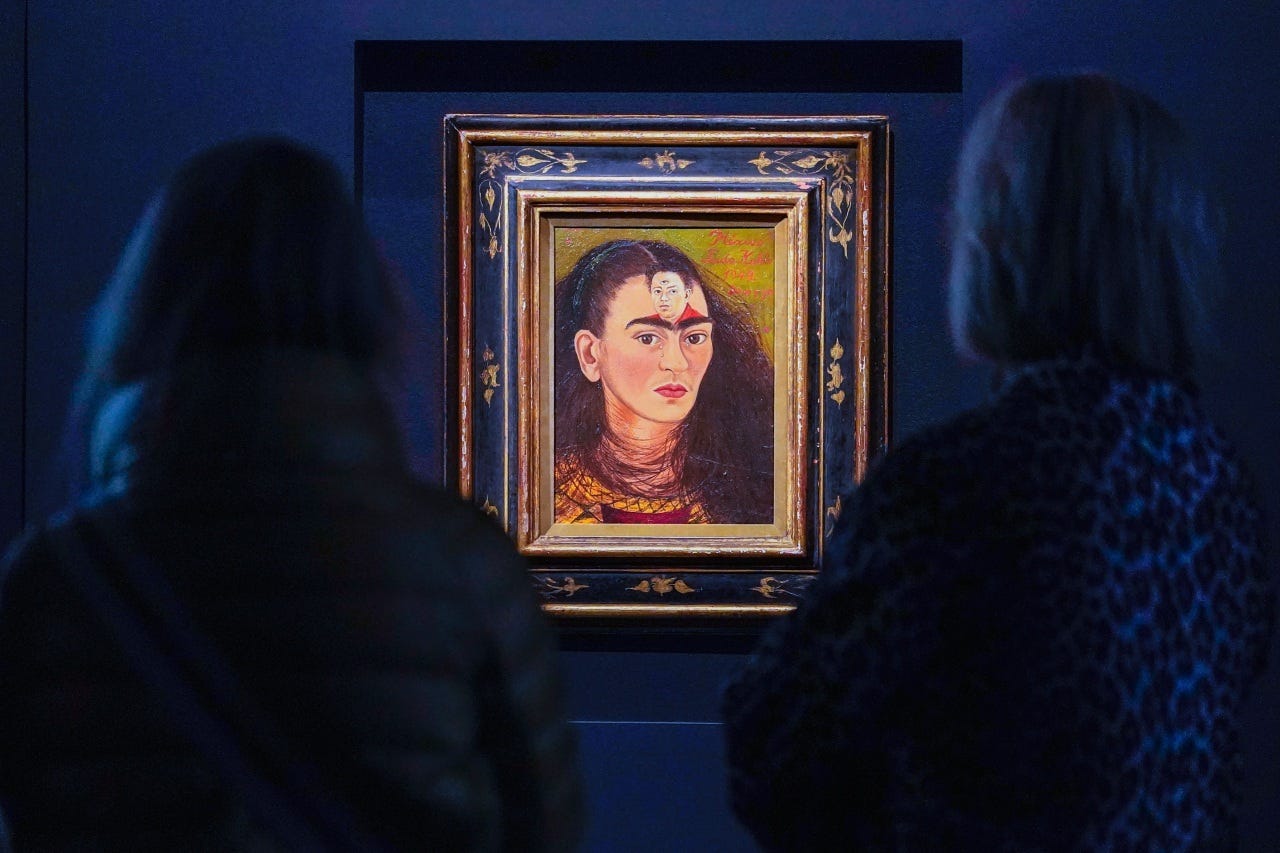
The face of Frida Kahlo is everywhere. It decorates the sides of designer handbags. It looks down from murals on city buildings. It even adorns the heads of Barbie dolls. The curator of “Frida: The Making of an Icon,” a new exhibition at the Museum of Fine Arts, Houston, calls Kahlo “the most conspicuous woman artist of all time.”
That’s a bold claim. It puts the Mexican painter ahead of popular Americans such as the impressionist Mary Cassatt and the modernist Georgia O’Keefe, as well as Artemisia Gentileschi, the 17th-century Italian.
Yet it may be true. Kahlo’s image is instantly familiar.
If Kahlo is an icon of anything, however, she’s an icon of Stalinism. She painted portraits of the murderous Soviet dictator. She scribbled “Viva Stalin” in her notebooks. She kept a photo of him by her bed, along with pictures of Marx, Engels, Lenin and Mao. “I love them all as the pillars of the new communist world,” she wrote in her diary.
Today she’s an art-world favorite. Sotheby’s sold one of her works last fall for nearly $55 million. She’s the subject of a new production at the Metropolitan Opera that debuts on May 14, plus a related exhibition at the Museum of Modern Art that runs through Sept. 12. The show in Houston is open until May 17.
When Kahlo died in 1954, she was an obscure painter, perhaps best known as the wife of Diego Rivera, the Mexican artist. Their relationship was rocky: They married in 1929, divorced in 1939, and remarried in 1940. Both were adulterers. The most sensational infidelity was Kahlo’s fling with Stalin’s rival, Leon Trotsky.
Rivera and Kahlo sympathized with Trotsky, helped him win asylum in Mexico, and welcomed him and his wife into their home in 1937. Once the communist leader moved in, Kahlo “deployed all her considerable seductive powers to attract Trotsky,” wrote Kahlo biographer Hayden Herrera.
Their affair proceeded from the bed to the canvas when Kahlo painted a self-portrait for her paramour as a birthday gift: “For Leon Trotsky with all love,” says an inscription. The original is on permanent display at the National Museum of Women in the Arts, in Washington, D.C.
The romance ended after Trotsky’s wife of 35 years discovered the truth. The Russians left the Rivera-Kahlo residence and moved to a house nearby. A little more than a year later, in 1940, an agent of Stalin infiltrated the staff and killed Trotsky with an ice axe.
Some communists viewed Trotsky as a martyr and remained loyal to his legacy as a foe of Stalin. Kahlo preferred to denounce him. “She turned on Trotsky like a cat with her claws out,” wrote Ms. Herrera. Kahlo even tried to push her liaisons with Trotsky down an Orwellian memory hole. “He was a coward,” she said in 1954. “He irritated me from the time that he arrived.”
It’s of course possible to distinguish between the public work of artists and their private lives, and to esteem one and not the other. Yet Kahlo blurred these categories. She turned her art into a tool of Soviet propaganda. One of her final paintings is about as subtle as its title: “Marxism Will Give Health to the Sick.” She suffered from physical maladies for much of her life, but she wanted to overcome them so she could inject politics into her paintings. “I should struggle with all my strength for the little that is positive that my health allows me to do in the direction of helping the Revolution,” she wrote in 1951. She called it “the only real reason to live.”
After her death, she gained fans, especially for her self-portraits. The art critic Peter Schjeldahl called her eyes “as riveting as the aimed barrels of loaded guns,” which is a grimly appropriate metaphor for a fangirl of Stalin. The U.S. Postal Service put her on a stamp. The actress Salma Hayek portrayed her in a movie. At some point, Kahlo became the left’s top fashion symbol, displacing the violent Cuban revolutionary Che Guevara, whose black image has glared from the red T-shirts of campus radicals for a couple of generations.
Che is still chic among leftists, but Kahlo is in vogue in the popular culture. As the Cold War has receded into history, her promoters have laundered her reputation. The hardcore Communist who revered and celebrated one of the 20th century’s worst death dealers has transformed into a well-meaning progressive. The catalog for the show in Houston deems her “a promoter of social justice.”
The Houston exhibition’s “lead global supporter” is Bank of America, in an act of sponsorship that recalls the quip often attributed to Lenin: “The capitalists will sell us the rope with which we hang them.” In this case, however, the capitalists aren’t even making a profit. They’re giving away the rope and congratulating themselves for their high-minded patronage of the arts.
Mr. Miller is a Free Expression columnist at WSJ Opinion.
Frida Kahlo is loved because her art doesn’t stutter as to its meaning. Above all else, her art is accessible and has a point. Unlike most modern art
Frida Kahlo is loved because her art doesn’t stutter as to its meaning. Above all else, her art is accessible and has a point. Unlike most modern art