

Capitalism Gets a Bum Rap
For many young people it’s simply a stand-in for the status quo. But the status quo is a huge improvement over the alternative.

Free Expression is a daily newsletter on American life, politics and culture from the Opinion pages of The Wall Street Journal. Sign up and start reading Free Expression today.
Capitalism has been getting a bad rap. According to one 2025 Gallup poll, only 54% of Americans have a positive view of capitalism. More Democrats think highly of socialism than capitalism. Another survey, from 2019, found that younger Americans were the least likely to have positive feelings about capitalism.
Why is this happening? One underrated factor may be that many Americans don’t have a strictly economic definition of capitalism. When I hear “capitalism,” I think of an economic system where goods are distributed by markets rather than governments. That, I’ve now realized when talking about economics online and in person, is an unusual perspective.
As Matthew Yglesias argued recently, when many people say “capitalism,” they mean “the status quo,” even if that status quo involves a lot of problems caused not by free markets, but by government regulation and cronyist intervention. The housing market, he notes, is the most obvious example of this: “Younger people’s lived experience of ‘capitalism’ is of central planning and massive shortages of the single most important item they consume.”
The result is that anything that seems to be going wrong in American life, no matter how large or small, no matter how unrelated to free markets, will pretty reliably be blamed on capitalism.
Which brings me to a vintage refrigerator.
Recently a video went viral showing the inside of a 1958 GE refrigerator. The appliance restorer behind the camera starts the video by declaring that “they don’t build things like they used to.” He then shows off some unusual features, like rotating shelves. Just about all the commenters seemed to think the reason modern refrigerators aren’t as nice as the one in the video is, you guessed it, capitalism.
“They made everything worse while making everything more expensive,” reads one comment with more than 46,000 likes. Another comment with thousands of likes declared that “capitalism is literally built on the premise that things are not reliable.”
This couldn’t be more wrong. This particular fridge was almost certainly far more expensive than a comparable appliance today. While I couldn’t track down the price for that exact model, I did find an ad for a similar-looking refrigerator in a 1958 Sears catalog. That refrigerator is listed at $399.95, around $4,600 today. A quick internet search reveals that most refrigerators today are much less expensive than that. When Wirecutter, a product-review website, made a list of the best refrigerators on the market earlier this year, only one of them came within $1,000 of the 1958 refrigerator’s price tag.
If you’re looking to drop $4,600 on a fridge for some reason, you’ll end up buying a luxury product. A similarly priced smart fridge is nearly 10 cubic feet larger than the 1958 one. It has a built-in ice maker (including a setting for making clear cocktail spheres), a special viewing window and a drawer with a “chilled wine” setting.
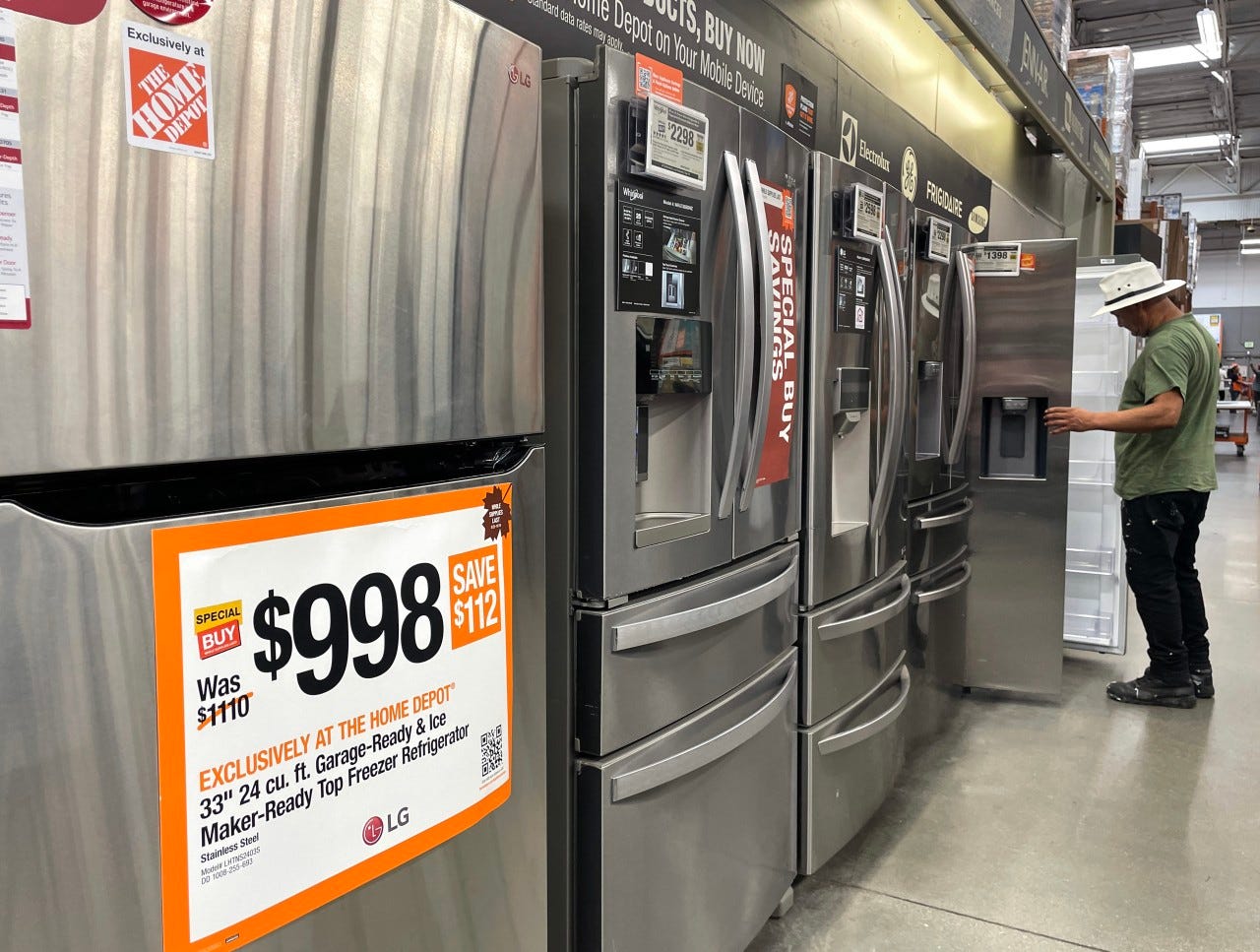
If that doesn’t convince you that appliances today are better than their midcentury counterparts, modern refrigerators are also much more energy efficient. And contrary to complaints that modern appliances are built to break, the longevity of our refrigerators has barely budged in 30 years. In 1990, 38.2% of family refrigerators were more than 10 years old. In 2020, it was 35.1%.
The median American looking to buy a refrigerator today is better off than his grandfather in the 1950s. The appliances themselves are cheaper, they’re better, and he himself is much richer, so it takes him fewer hours of work to be able to afford an equivalent expense. Competition from imports and technological innovation, both hallmarks of free-market capitalism, are why our appliances are bigger and better than they once were.
Capitalism, as it turns out, isn’t why you can’t have a cool vintage refrigerator. It’s why many of us can afford refrigerators in the first place. In 1950 about 20% of homes didn’t even have refrigerators.
When “capitalism” is an all-purpose scapegoat for any problem, it’s easy to take for granted America’s considerable material abundance. In this case, the problem seems to be more about the fact that vintage appliances look cool than anything else, plus a mistaken belief that modern refrigerators don’t last as long.
The status quo is far from perfect. Young Americans are facing real affordability problems, most obviously in the form of a housing crisis caused by government regulations that impede new construction. But while we may not have a utopia, we also live in a world that’s better than anything our forebears had to contend with. It’s much better to live in a world with abundant, inexpensive consumer goods—a world in which people can become jaded about those cheap products—than a world where necessities are costly. I’ll take my modern fridge any day.
Ms. Camp is senior newsletter editor at Free Expression.
Fridges 10 years old? Pikers! In March of this year, our upright freezer purchased in 1981 failed. I think 45 years is a pretty good appliance life. Unfortunately, it failed while my wife and I were out of town, and the putrefaction was spectacular, and the cleanup was ..... ahem....