

Christopher Nolan’s Critical Odyssey
The director’s version of the epic will stand or fall on whether it finds epic visions in the American demotic.

By Dominic Green
Free Expression is a daily newsletter on American life, politics and culture from the Opinion pages of The Wall Street Journal. Sign up and start reading Free Expression today.
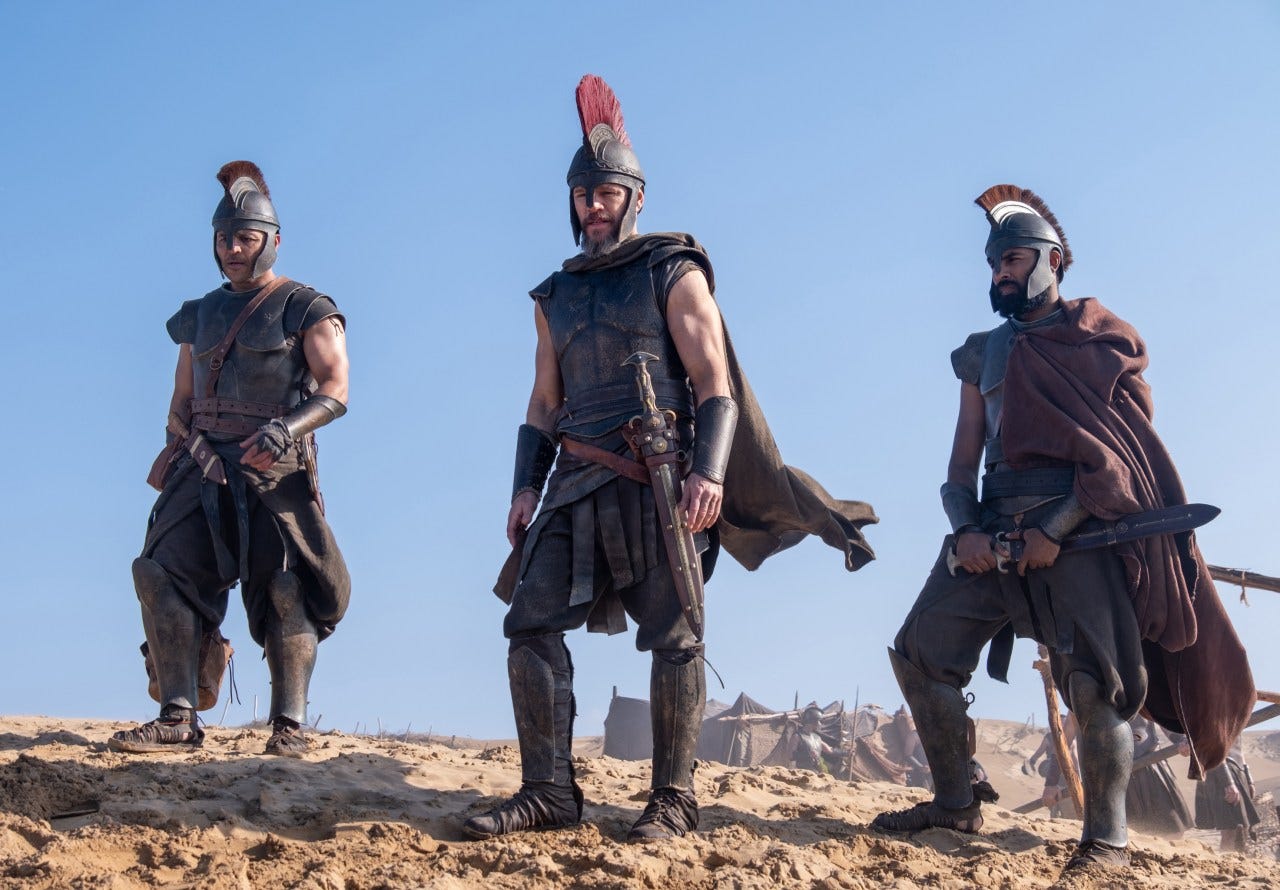
Christopher Nolan’s adaptation of Homer’s “The Odyssey,” out on July 17, is the most hotly awaited sword-and-sandal epic since Ridley Scott’s “Gladiator” (2000). More than Hollywood’s future is at stake. Ancient or modern, every civilization needs its epics. Mr. Nolan revived Batman’s mythology in the Gothic Gotham of “The Dark Knight” and Space Age nostalgia for the American future in “Interstellar.” Can “The Odyssey” bring it all back home in America’s 250th summer?
The film’s second trailer, released on May 5, was the clip that launched a thousand tweets. A new genre set sail on the wine-dark sea of social media: the pre-review, in which two armies of keyboard warriors debate a film neither side has seen. Some of the complaints were about as edifying as being clubbed on the head with a war hammer before the walls of Troy. But others entered the fray wielding the thrusting spears of philology, the hand axes of period costume, and the trusty shield of certainty that the bad guys should, as they did in the age of Hector and Achilles, speak with posh British accents.
A chorus of kibitzers complained that Matt Damon’s Odysseus speaks with a Boston accent, as though the Ithacan warrior wandered in Southie for 20 years. It didn’t help that Mr. Damon cried “Let’s go!” as he led his warriors into battle with the urgency of a dad hurrying his kids to the parking lot at Gillette Stadium before the chariots back up on I-95. Nor did it help that battle was joined under a dank northern sky, not the usual Mediterranean cerulean, and soundtracked not with bronzed horns or deer flutes or whatever the Hans Zimmers of the Bronze Age used, but a formless electronic rumbling that sounded like it was recorded in a Mycenaean storm drain.
Odysseus’ decade before the walls of Troy was nothing compared to the culture war. The armchair punditry griped like Odysseus’ oarsmen on their benches. They complained that the Kenyan-Mexican actress Lupita N’yongo playing Helen of Troy was “woke casting.” They complained that the rapper Travis Scott could not play a Homeric bard, because Mr. Scott’s oral tradition is inferior to Mr. Homer’s, though no Greek spoke in Homer’s language. They complained about little Elliot Page playing Achilles, until it turned out that Elliot Page almost certainly isn’t playing Achilles. As the English wag Sydney Smith said, “I never read a book before reviewing it; it prejudices a man so.”
Actual Greeks complained that no actual Greeks were hired in the making of this movie. John Leguizamo, who once complained that only actual Latinos should play Latinos on film, didn’t complain about taking a check for playing Odysseus’ swineherding sidekick Eumaeus. “Chris Nolan has shown total contempt for the Greek people,” Elon Musk said on X.com, the platform he owns. Everyone’s a critic.
A hardy band of the last sane voices on social media rallied to the side of the stricken Mr. Nolan. Seasoned spear-carriers noted that the wintry palette of “Jason and the Argonauts” had a formative influence on Mr. Nolan’s aesthetic, so let him park Zendaya as the goddess Athena on what looks an English beach in November. True, Tom Holland, as Odysseus’ home-alone son Telemachus, says, “My dad’s coming home” as if he’s in a sitcom in Ithaca, N.Y., rather than saying something mock-epic like “My father shall return.” Mr. Holland, a Brit, speaks with an American accent. Everyone else in the “Odyssey” trailer speaks American, too, just as Charlton Heston’s Moses, Kirk Douglas’s Spartacus and Willem Dafoe’s Jesus did.
The power, the poetry and the suspension of disbelief depend on the conviction of the performers and the internal consistency of the translation. Like the Coen Brothers’ “O Brother, Where Art Thou?,” Mr. Nolan’s version will stand or fall on whether it finds epic visions in the American demotic.
One shot in the trailer shows Mr. Damon’s Bronze Age killer floating face-down in the water, just as Mr. Damon did in “The Bourne Identity.” Jason Bourne is an American hero who doesn’t know why he fights, because he suffers from what the Greeks called amnesia. Homer’s Odysseus is a Greek hero who beats on, “boats against the current, borne ceaselessly back into the past” by his nostos, his longing for home and family. Homer’s saga of violence, failure, striving and longing has found a home in the American imagination. If we dislike some of the shadows thrown by the flickering lamp of Mr. Nolan’s interpretation, it may be because we recognize the images.
The combat of champions, and the possibility of American heroism in the age of Homer Simpson, came down to one word. Fortune blessed our hot-thumbed Hellenists by placing it in the first line of Homer’s proem, his opening invocation of the Muse: the keynote characterization of Odysseus as polytropos. An online cribsheet allowed us to compare the translations of T.E. Lawrence (“various-minded”), Robert Fitzgerald (“skilled in all ways of contending”) and Robert Fagles (“twists and turns”), with Mr. Nolan’s source Emily Wilson, whose 2017 “Odyssey” demystifies Odysseus as “complicated,” a PTSD case of toxic masculinity.
The battle of the translators was often dirty and sometimes cruel, but in the heat of their striving they found the telos, the drive and purpose, of an American “Odyssey.” They also showed a spontaneous, deep and serious public appetite for literature and language, myth and meaning. Homer, who invented the sequel, still has a lesson for Hollywood.
As dusk fell, the lone voice of another translator, Daniel “so many roundabout ways” Mendelsohn, sounded across the blood-soaked field. Lyre in one hand, iPhone in the other, Mr. Mendelsohn offered his “night thoughts” on polytropos. After the struggle in the digital Lyceum, his calmly expert oration was the last word about Homer’s first adjective. All now know what Homer might have meant. We are ready to continue his domestication by transferring polytropic from the technical language of thermodynamics to everyday American English.
Mr. Green is a Journal contributor and a fellow of the Royal Historical Society.
Yeah no thanks. If this was supposed to be up,if ting and make people want to see it, it totally failed the mark.
Sounds like this movie is stupid.