

Clarence Thomas’s America
Earlier this year the Supreme Court justice explained the political philosophy of the American Founding—and what’s required to preserve it.

Free Expression is a daily newsletter on American life, politics and culture from the Opinion pages of The Wall Street Journal. Sign up and start reading Free Expression today.
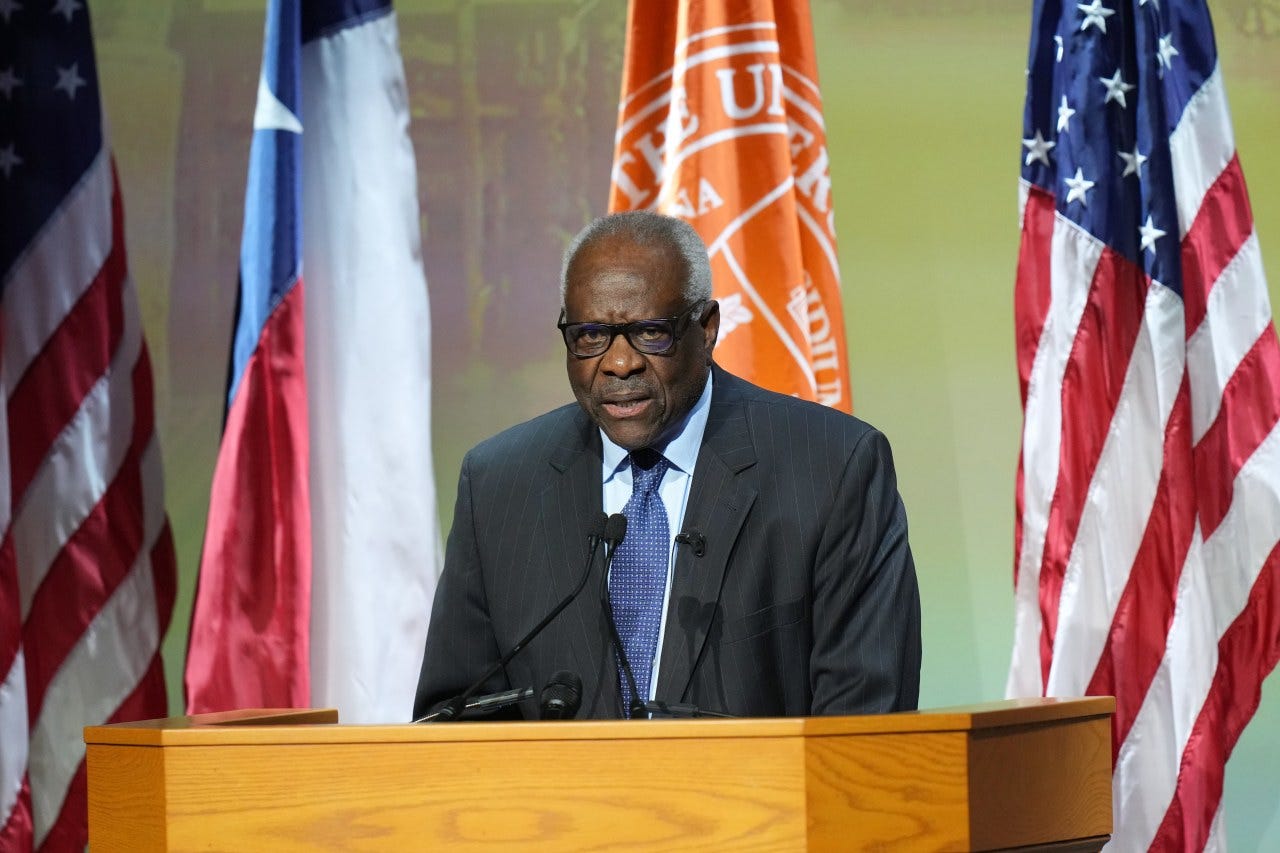
There will be plenty of speeches to mark America’s 250th birthday, but none will have the power of an address delivered this past April at the University of Texas at Austin. The speaker was Supreme Court Justice Clarence Thomas. His message: Nothing less than the political philosophy of the American Founding—and what’s required to preserve it. When Justice Thomas talks, pay attention.
Watch or read Justice Thomas’s remarks, and you’ll notice they begin conventionally. He thanks his hosts, greets colleagues and acknowledges friends. Then he shares a story that ties his biography to the enduring principles of the Declaration of Independence. What appeared at first to be an ordinary speech becomes something special. His argument isn’t only that ideas matter. It’s that the success of an idea depends on our willingness to sacrifice for it.
When Justice Thomas was in grammar school, he’d begin each day by joining his class for an outdoor flag ceremony. The American flag would be raised; students would recite the Pledge of Allegiance; and class would begin soon after. This was during the segregation era, when black people were treated as second-class citizens.
“Even as so much of our God-given and constitutional rights were denied us,” Justice Thomas said, “we still faithfully said the Pledge of Allegiance, memorized the preamble to our Constitution and yearned for the fulfillment of its promised ideals.”
Those ideals were part of Justice Thomas’s upbringing. “Despite the multiplicity of laws and customs that reeked of bigotry,” he said, “it was universally believed among those blacks with whom I lived and who had very little or no formal education, that in ‘God’s eyes and under our Constitution, we are equal.’ ”
Political equality wasn’t a government entitlement, but a gift from God. It had the force of revelation. Governments can violate a man’s rights. They can prevent him from exercising his rights. But they can’t erase the truth of those rights. Why? Because they’re part of his nature. They’re built in.
“The Declaration made clear in clear prose that the purpose of government is to protect our God-given inalienable rights, rights that all individuals equally possess,” said Justice Thomas. Note his repetition of “clear”—for indeed the clarity of the document helps explain its influence over time. The echoes of the Declaration have been heard in the debates over slavery, in the cannon fire of the Civil War and in the songs of the civil rights movement. They are heard even today, Justice Thomas said, in the cries of “people throughout the world to throw off the shackles of their oppressors.”
If the Declaration’s second sentence—“We hold these truths . . . ”—outlines America’s foundation, the Declaration’s final sentence reveals what’s necessary to achieve and maintain equal freedom. That sentence reads as follows: “And for the support of this Declaration, with a firm reliance on the protection of divine Providence, we mutually pledge to each other our Lives, our Fortunes, and our Sacred Honor.”
The Founders looked to God, but also to each other, knowingly putting their lives at risk. Without their commitment, their willingness to stand against the greatest military in the world, the Declaration would have been meaningless. “What changed the world was not the words,” Justice Thomas argued, “but the commitment and spirit of the people who were willing to labor, sacrifice and even give their lives—what Lincoln at Gettysburg called ‘the last full measure of devotion’—for the Declaration’s principles.”
Justice Thomas wonders if America’s reserves of courage and devotion are running low. For him, courage is the act of standing alone. It means doing what’s right even though it’s unpopular or costly. Devotion might mean risking one’s life in combat. But it also can mean self-denial so that one’s children have an education and a chance at a better life.
The Western pioneers, U.S. servicemen through the ages and the passengers on Flight 93 acted bravely in defense of the American experiment in self-government. Where else can we find Americans who put their lives, fortunes and honor on the line for their country?
Not the Beltway. Washington, D.C., so often disappoints, Justice Thomas said, because too few in the political class are willing to lose “popularity, flattery, comfort and security.” Too few in the political class understand the final sentence of the Declaration. And because they’re unwilling to bear the full cost of the Declaration’s principles, they take the path of least resistance—or adopt new principles.
When courage fades, rival ideas prevail. Justice Thomas criticizes progressivism as a rejection of the American Founding. He points to Woodrow Wilson, who strove to replace constitutional government with a system based on European parliamentary models. In Justice Thomas’s view, progressivism denies natural rights in favor of contingent truths and government-granted freedoms.
By trying to make America more like Europe, progressives denied what made America great: our tradition of equal freedom under law. And by rejecting natural rights and the colorblind Constitution, Justice Thomas says, progressives opened the door to intrusive government, eugenics, forced sterilization, group preferences, identity politics and now socialism and antisemitism.
Conservatism’s task is to resist and roll back progressivism while restoring the Founders’ vision to American life. It isn’t an academic exercise. “What we must turn our attention to today is finding in ourselves the same level of courage that the signers of the Declaration had, so that we can do for our future what they did for theirs,” Justice Thomas concluded.
The price will be high. “But, if you stand, you will find that courage, like cowardice, can be habit-forming—a part of your life and who you are. And, I may dare say, it is liberating. You will also be a living example for others to emulate.”
A living example like Justice Clarence Thomas.
Mr. Continetti is a Free Expression columnist at WSJ Opinion.
 | A guest post by
|
It is a speech that should be shouted from the rooftops and pulpits of our beloved country and, instead, what we got was the likes of the NY Times saying "Thomas attacks progressives"!
These partisans can only lie about the great men and women of our country.
If only he lived his words...