

Every Dog Has His Daybed
We need to stop treating pets like they’re human children.

Free Expression is a daily newsletter on American life, politics and culture from the Opinion pages of The Wall Street Journal. Sign up and start reading Free Expression today.
I should state from the outset that I like dogs. Specifically, I like dogs that are large, mongrelly, ungroomed and live mostly outdoors. The sort of dogs who mosey up to you for a pat before returning to patrolling their territory and occasionally chasing a cat. I like cats too, to be clear. But I like dogs who behave like dogs and cats who behave like cats, and that implies a certain level of animosity between the two species. Children’s cartoons used to have a lot to say on this.
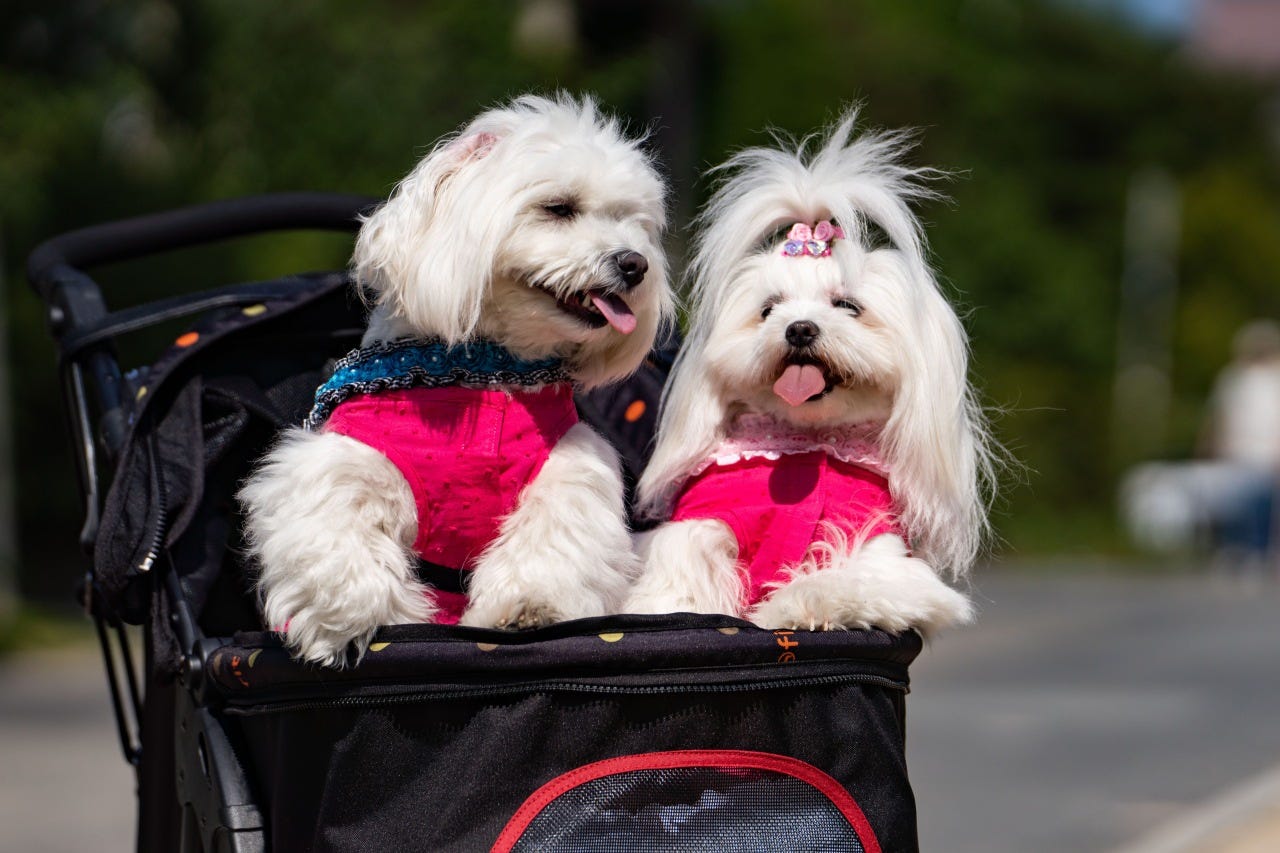
What I do not like is “fur babies.” Still less do I like the “pet parents” who hoist their animals into prams, slings and clothing as if they were infants. I recoil at hearing a dog owner described as “mommy,” or “daddy,” or—worse—a “yummy puppy mommy.” The fanciest “YPMs” spend vast sums of money on the care of their dogs, gathering in restaurants like Culina, at the Four Seasons in Los Angeles, where the “pet menu” includes “grain free dog biscuits” for $21 a platter.
Two once-noble species are being humiliated here. Over the course of tens of thousands of years, we have developed a unique emotional attachment to dogs, and through selective breeding have given them anthropomorphic traits like expressive eyes and an ability to form close friendships with us.
In the era of low fertility, these traits have proved irresistible to humans in search of an outlet for frustrated maternal or paternal instincts. Many “pet parents” will admit this without shame. You can easily source a T-shirt, mug or tote bag with a slogan like, “My favorite child is my dog” or, “Yes, my dogs are my children, get over it.” In the modern era, dogs originally bred to be our sentinels and hunting companions have proved to be very effective at what biologists call brood parasitism. That is, they (unwittingly) exploit the parental instincts, resources and care of another species, much like cuckoos who leave their eggs to incubate in the nests of other birds.
The American Time Use Survey reveals that the average amount of time spent on pet care has risen persistently in recent decades. Americans are spending less time with their friends, less time caring for elderly relatives, and the birthrate is at a record low. Into this lonely breach, the dog has emerged as a willing receptacle for emotions that might otherwise be directed toward humans.
Not so long ago, dogs played a very different role in our lives. My mother grew up in suburban Australia in the 1960s, at a time when dogs would wander around the neighborhood on their own, enjoying their freedom before heading home to be fed and to sleep in an outdoor kennel. One of the family dogs returned one day with half her tail missing. She was taken to the vet to have the wound tended to, and then returned to her roaming. No one found this laissez-faire attitude strange, in large part because this was during the postwar baby boom and everyone was too preoccupied with raising children to worry too much about the dogs.
I just checked a local Facebook group for this same suburb and found a photo of a pair of very nice-looking dogs—retriever crosses, I would guess—who were playing by the creek without human supervision. Sixty years ago, this would have been unremarkable, but times have changed. “Please report this to the council ranger,” reads the first comment, “these guys are unfortunately repeat offenders.” No one claimed the dogs were doing any harm, so what was the problem? Can’t a dog take himself for a walk nowadays without being ratted to the authorities?
Answer: no, not anymore. The increased vigilance around free-roaming dogs is partly a consequence of increased road traffic over the past half century, which has made owners more cautious about letting their animals out alone. We’re also more anxious about the negative effect that pets have on the local environment, particularly bird life, and more aware of the risks of litigation if a dog causes damage.
We also think of our dogs differently nowadays. Their “petification” has seen them confined to the owner’s property, frequently left alone for much of the day, and with little opportunity to socialize with other members of their species. Such dogs are less likely to suffer accidents like tail amputation, but they are more likely to suffer from obesity, separation anxiety and depression.
Worse still are the health problems seen in dogs designed to look like human babies. Owners in search of a baby replacement are often drawn to neotenous features like big eyes, round faces and disproportionately large heads. In particularly babyish breeds like pugs and Boston terriers, breeders have doubled down on these traits to such a degree that many dogs suffer from breathing problems due to their excessively short snouts, or have been burdened with eyeballs so large that they are incapable of properly blinking.
There are tragic consequences for the “pet parents,” too. Like a pornography habit, finding regular release for instinctive urges can deaden the desire to seek out the real thing. And while dogs may be a more easygoing addition to one’s life, they will never offer the satisfactions of parenthood. They also have short lives, causing incommensurate grief to an owner convinced that her dog is her child.
Perhaps we should be more blunt with the “yummy puppy mommies.” Much like the late Pope Francis, who in 2023 told an audience in Rome about an occasion on which a woman had asked him to bless her dog, calling it “my baby.” “I lost my patience and upbraided her,” he recalled. “Many children are hungry and you bring me a dog?”
I wish we could return to a more old-fashioned attitude toward pet ownership. You do still come across free-roaming dogs from time to time in rural areas. The last such dog I met was a lovely old girl called Pepper who lived outdoors on a farm. She smelt like sunshine and dust baths and was the most contented dog I’ve encountered in a long time. As I say, I really like dogs. Not because they are babies, but because they are dogs.
Ms. Perry is a Free Expression columnist at WSJ Opinion.
 | A guest post by
|
It's not like a cat, every time I see a young couple with a dog, it clearly means they really do want a child, want an anchoring co-responsibility and something to love, but have wrongly decided the dog will be less of a burden on their lives. But a dog needs walking twice a day, clearing up after its poo, feeding twice a day, can't be left alone long, and means you can't go wherever you want for holidays. Just have a child at this point! How hard do these young people think a child is? It's obviously more work than a dog, but not to the extent of not having a dog at all. I also think increasingly a lot of young women who do want children, are in relationships with men who don't, or are happy to delay. So they get a dog in the meantime.
I'm also noticing a performative kind of childishness here as well in young women: cooing over their dog and cat "babies". I associate it with people who wear headbands with ears. Grow up already, whether or not you choose to have pets or children.