

Fighting for Blueberry Pie
Alistair Cooke’s account of America during World War II reveals the nation’s industrious spirit.

Free Expression is a daily newsletter on American life, politics and culture from the Opinion pages of The Wall Street Journal. Sign up and start reading Free Expression today.
British-American journalist Alistair Cooke was weeks from death in 2004 when his secretary, Patti Yasek, discovered papers in a closet: unpublished manuscripts he had written about his tour of the U.S. during World War II. “The American Home Front: 1941-42” was published in 2006. Good thing for us. Cooke’s reporting—a vivid tour of America’s landscapes and its people—is a worthy tribute to revisit for the country’s 250th birthday.
A newly naturalized citizen living in New York City, Cooke set out from Washington, D.C., in February 1942 to travel by car, rail and airplane to every region of the country. He went to learn the mettle of the American people and wasn’t sure what he would discover. “We tend to assume that war will endow people with a completely different and more elevated set of emotions to live their lives on,” he writes. “I was theoretically willing to be convinced that the war would improve the quality of human emotions, but like the man from Missouri, I wanted to be shown.”
What did he find? Cooke’s account is of quintessential American virtue: not righteous or saintly emotion, but morally rooted industriousness. Whatever their feelings—and often they were begrudging—Americans were ambitiously productive for a cause their country called them to. As Cooke said in a BBC radio broadcast in 1943, Americans’ war sacrifice, compared to that of other countries, has “a special American twist.” It’s largely one of industry and agriculture.
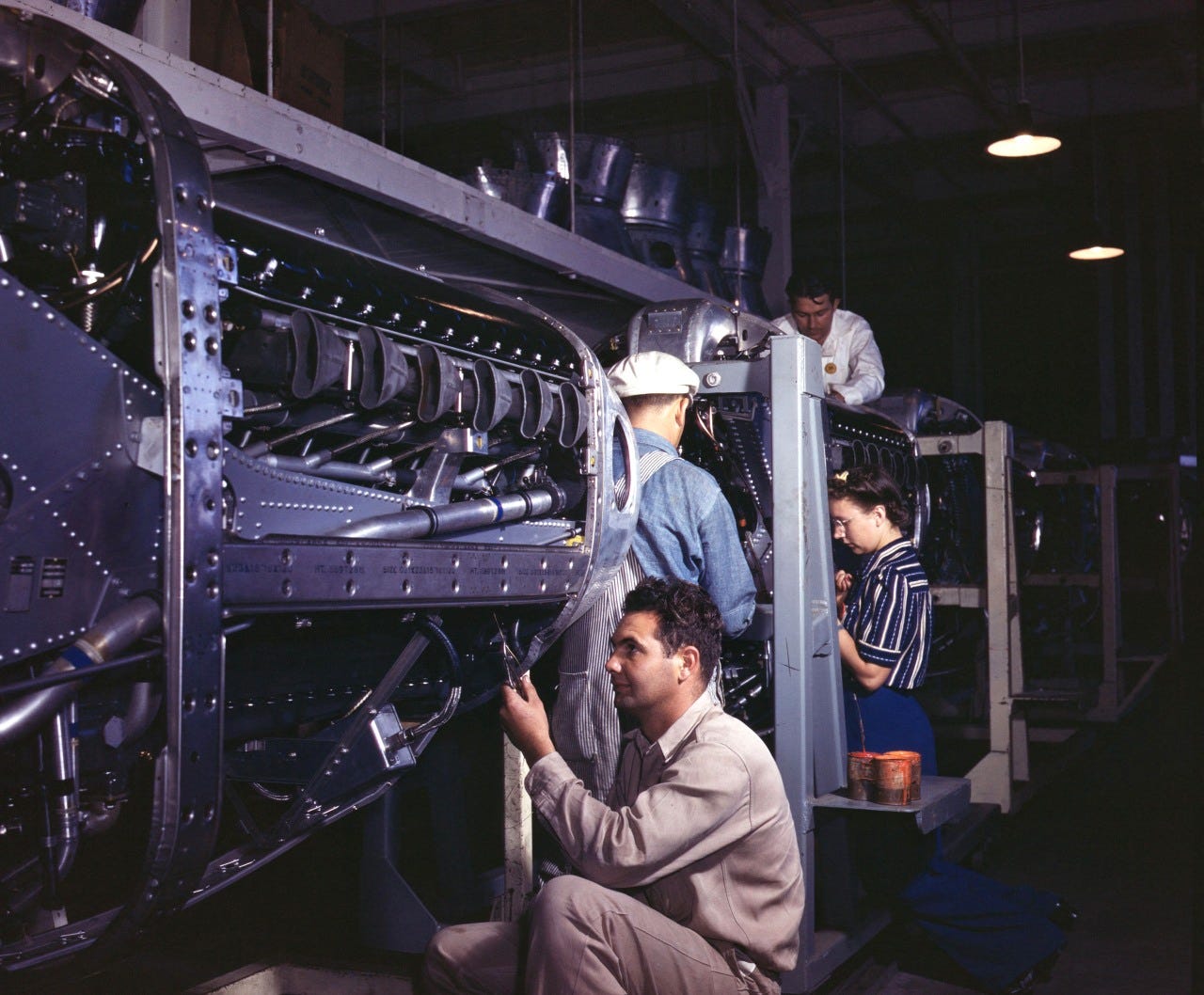
We know that marvelous American industrial fervor sprang from World War II, but it’s enlightening to read Cooke’s dogged account of lives and industries uprooted for the war effort. He tells of Pacific Northwest lumber dedicated to the military: “Spruce for airplanes, redwood for tanks.” Wisconsin overhauled its dairy production.
In Chicago, they make “airplane parts instead of electric irons, tanks instead of refrigerators, small rifles instead of automobile parts.” Towns whose industries can’t be used or converted—like granite in Barre, Vt., though industry groups suggested the need for tombstones might save them—suffer.
Cooke notes the “bubbling inventiveness, the audacity, the wit even, that mass production could in a crisis stimulate” as he observes the conversion of auto manufacturing to bomber production in Michigan. He finds in Los Angeles a “pride in the unexpected resources of America, which can overnight change ‘nineteen suburbs in search of a city’ into a throbbing airplane hangar.”
Along the way, Cooke describes only-in-America characters like New Orleans boatbuilder Andrew Jackson Higgins, who is “big business in person” and “appallingly successful.” But he also finds regular, earnest people. There’s a young lad running an ice-cream truck who explains the wartime hit to Good Humor bars: “They’re using sugar syrup instead of glucose. And we shall lose a lot of flavors.”
Cooke describes American ingenuity in sharp detail, like clever methods for making the most of every part of an orange. A tin shortage means foods are dehydrated instead of canned. An upheaval of labor means everyone does all kinds of jobs.
Industrial policy makes an unpredictable mess—“the whole hierarchy of food values is likely to be upset by government decree,” he notes in California—and he hears griping about Washington. “Ordinary people,” Cooke writes, “think first and always about the way the war affects their work.”
But the practical-mindedness isn’t selfish. “Americans temperamentally don’t like much government,” Cooke said in his 1943 broadcast, which was delivered two days before Independence Day. “They think of it as a healthy man thinks of a surgeon’s knife. And when somebody tries to ration their life, their liberty, and their pursuit of happiness, they feel that they’re being forcibly plumped on an operating table.”
A moral impulse is at the heart of this none-too-quiet sacrifice. “They are doing this because they cherish fiercely the things that their nation stood for when it was created 167 years ago, and that it stands for now,” Cooke said. “The boys in the Pacific, one of them said, are fighting for blueberry pie . . . . There are some big things, the right to vote into power any man or government they want. The right to live in their own house and bring their children up as they please . . . and say what’s on their mind whether Washington agrees or not.”
It’s a question today whether Americans—especially younger ones enamored of socialism and of nonprofits over business—have this same capacity for industriousness and sacrifice. We live in fairly comfortable times. When hard times come, one hopes a journalist could still traverse America and find flintiness and ingenuity, and even a grumbling love for this country.
Ms. Ault is an assistant editorial page writer at WSJ Opinion.
 | A guest post by
|