

Gone to Australia
I’m leaving the U.K. because things are bad there, and I expect them to get worse.

Free Expression is a daily newsletter on American life, politics and culture from the Opinion pages of The Wall Street Journal. Sign up and start reading Free Expression today.
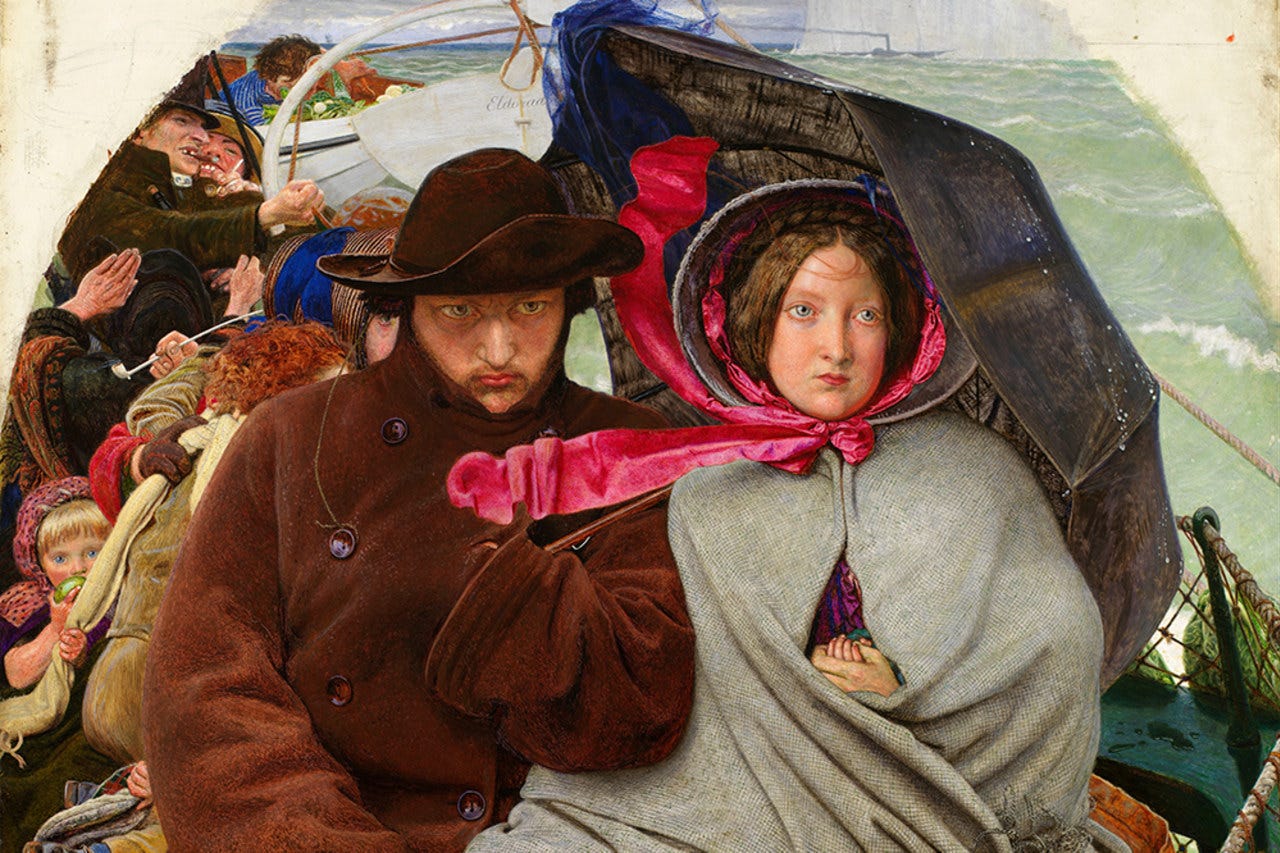
“The Last of England” is an 1855 painting by Ford Madox Brown that depicts a family leaving Britain for Australia. The white cliffs of Dover disappear behind them, but they don’t look back. The eyes of the mother and father are fixed ahead, their expressions stony. The woman holds the tiny hand of a baby who is tucked beneath her shawl, while her other hand is held by her husband. Voted one of Britain’s greatest paintings in a 2005 poll run by BBC Radio 4, “The Last of England” expresses a painful relationship with the mother country—a place to run from, and to grieve.
Some of my ancestors underwent a journey much like this, leaving Britain for Australia during the gold rush of the 1850s. I made the same journey last week with my husband and our two little boys. Our experience was a whole lot easier than that of the past. The flight is lengthy and unpleasant, but nothing like a weekslong journey by ship. Still, the expressions on the faces of Madox Brown’s subjects made sense to me. In the months leading up to our departure, a lot of people asked if we were feeling “excited” and the answer I always gave was “no.” As we said goodbye to the country of my birth, I felt bitter and heartbroken. Not because I don’t want to live in Australia—a beautiful country, and my other home—but because I never planned on leaving Britain.
So if we’re not “excited” about our move, then why did we do it? This is an awkward question to answer in casual conversation. A lot of British émigrés complain about fleeing the bad weather, but it isn’t obvious to me that the blasting heat of an Australian summer is necessarily preferable to British drizzle. And while the other standard push-and-pull factors do apply to us, they don’t tell the whole story.
It’s certainly true that healthcare is better in Australia and salaries are higher, since Australia is now a significantly richer country than Britain, the two countries having diverged following the 2008 financial crisis. Britain used to be the aspirational destination for ambitious young Australians—including my parents—but that is no longer true, and Australia has been merrily brain-draining Britain for some time now. Our move is perfectly rational in economic terms.
But there is another reason for leaving, one that is more difficult to say out loud. I’m not only unhappy with how things are right now in Britain, I’m worried that they’re set to get a whole lot worse.
I started thinking seriously about leaving Britain in 2024, spurred by two things: my direct experience of the dire state of NHS maternity services, and my unease about the rise of Muslim sectarianism in politics. This was the year in which the “Gaza Five,” a group of politicians who ran on an Islamopopulist platform, were elected to Parliament. These candidates ignore the liberal universalist ideals that other British politicians are committed to, instead making explicit appeals to ethnoreligious solidarity.
Meanwhile, the Pakistani Muslim-dominated cities of Birmingham, Oldham and Bradford have seen multiple cases of arson attacks on politicians’ cars in the lead up to elections, as well as tire-slashing and threatening messages scratched into the paintwork. Violence is a feature of elections in Pakistan. Is it so very surprising that we are now seeing the same disorder in Pakistani-majority areas of Britain? Paying close attention to current affairs is part of my job, and it became apparent to me that British politics was changing, and not for the better.
I sought out scholarly opinion on the matter, and came across the work of David Betz, a professor of war studies at King’s College London. A mild-mannered Canadian who specializes in the study of insurgency, Mr. Betz has provided expert advice to the British government on combating insurgent groups in Iraq and Afghanistan. Since 2019, along with fellow academic Michael Rainsborough, he has been warning about a threat closer to home: a fracturing within British society that seems to presage violence.
Mr. Betz and I corresponded by email for some months, and at the beginning of 2025 we spoke on my podcast. I was, I believe, the first journalist to interview him. The public response was extraordinary, no doubt because Mr. Betz’s analysis was delivered in such a calm, reasoned tone, and because his message tallies with what so many of us laypeople have observed about the direction things have gone in recent years.
He uses established models and ideas within the discipline of war studies to predict that Britain and France are the Western countries most likely to experience the outbreak of a violent civil conflict that would be fought primarily along ethnic lines. Such conflicts would be the product of economic stress, lost political legitimacy, indigestible levels of immigration from culturally distant places and a sense of “downgrade” among a native population that feels itself to be losing power and status. Britain is, says Mr. Betz, “explosively configured.”
In an article co-written last year with M.L.R. Smith of the Centre for Future Defence and National Security in Canberra, Australia, the two academics underlined the increasingly mainstream status of these predictions:
The strategic logic underpinning the argument is not esoteric. The warning signs—erosion of trust, delegitimised politics, social disintegration, elite denial—have long been legible . . . [T]he steady trickle of retired police chiefs, former civil servants and security officials privately voicing concern indicates that the thesis is apprehended even if never formally endorsed.
It’s possible that these predictions are wrong, of course. But nothing that has happened since 2024 has made me feel more confident about Britain’s trajectory. Since then, we have seen more outbreaks of race rioting and increased political instability. And, all the while, experts warn that the government is borrowing and spending way beyond its means, with welfare spending exceeding income tax revenue. This economic pain will be intensified by the loss to emigration of both the wealthy and the youthful which seems to be under way. A poorer Britain is hardly likely to be a more peaceful Britain.
I realize that I’m contributing to this potential doom loop by leaving. Anecdotally, a lot of my peers are thinking along the same lines. A message I received from a friend over the weekend: “every cell of my body wants to emigrate.” If Britons with the means to leave start to do so at scale, then a crisis of mass emigration could be at hand.
Some in Britain will accuse me of cowardice and treachery, not only for leaving, but also for writing about it and thereby encouraging others to do the same. I did think seriously about drawing a veil over my own emigration, and never publicly explaining why we had done it. But people kept asking, and I grew tired of not telling the whole truth.
My defense is that we wouldn’t have left if it weren’t for our children. That’s why the detail in “The Last of England” that now draws my focus is the one in the center of the painting: the mother holding her baby’s hand.
Ms. Perry is a Free Expression columnist at WSJ Opinion.
 | A guest post by
|
It strikes me as profoundly sad that calm, reasonable people such as yourself could be driven to the ultimate expression of dissent, which is leaving, and that there were warnings all along that went ignored.
As you and many others have pointed out countless times, you can't just let unlimited amounts of people from indiscriminate cultures into your country and expect everything to remain fine. Part of having a functioning, well, anything, but particularly a culture or a democracy, is exclusivity. It's not just a suggestion, it's required. If you let a bunch of G.R.R. Martin fans into your J.R.R. Tolkien book club, it won't be long until you're no longer talking about The Lord of the Rings.
I’ll watch your interview about the coming revolution tonight, but in the meantime, did anyone vote for net zero, Islamic illegal immigration, free housing for any immigrant or “gender” mutilation? No? Some group overthrew your government, and no one tried to fix it.