

How ‘The Odyssey’ Evolved
The epic poem popularly attributed to Homer almost certainly grew out of a much older oral tradition.

Free Expression is a daily newsletter on American life, politics and culture from the Opinion pages of The Wall Street Journal. Sign up and start reading Free Expression today.
The man at the foundation of Western literature probably couldn’t read or write. Homer almost certainly was illiterate. An American professor proved it nearly a century ago.
If this is hard to believe, it’s because we tend to encounter “The Iliad” and “The Odyssey” on the printed page. These epic poems are staples of courses on the Great Books. They’re classic texts contained in thick tomes, worthy of silent study and solemn reverence.
Yet they’re also adaptations, like director Christopher Nolan’s movie version of “The Odyssey,” which arrives in theaters this week. In fact, the works of Homer were adaptations from the start.
This was the central insight of Milman Parry, who devoted his short life to understanding Homer. As Robert Kanigel put it in “Hearing Homer’s Song,” his 2021 biography of the scholar: “Classicists today refer to ‘before Parry’ and ‘after Parry.’ They speak not of Parry’s ‘theory’ or ‘argument,’ but of his ‘discovery.’”
Parry confronted a basic mystery: Who was Homer? Academics call this the “Homeric Question.” For generations, they debated dates and methods of composition. Yet the historical record is so scant from the centuries before what is often called the “Golden Age of Greece”—the heyday of Pericles and Socrates—that their best answers were often simply guesses.
The ancient Greeks thought that Homer was an actual person. This remained a conventional view into the 20th century: Homer was a singular genius, like writers such as Virgil, Dante and Shakespeare. In the 18th and 19th centuries, however, a few scholars began to speculate that “The Iliad” and “The Odyssey” emerged from an oral tradition rather than from the mind of one person. What they lacked was proof.
Parry provided it, through a combination of textual analysis and fieldwork. He argued that the most-repeated phrases in the poems—“wine-dark sea,” “swift-footed Achilles” and so on—served a special purpose. They allowed singers who composed on the fly to make their lines fit the rhythms of dactylic hexameter. They were also aids to memory. Parry was like a detective at a crime scene. With every written reference to the “rosy-fingered dawn,” he saw the fingerprints of an oral culture.
Next, Parry road-tested his hypothesis. In the 1930s, he traveled to the hinterlands of what was then Yugoslavia and tracked down some of the world’s last remaining epic singers. Known as “guslari,” these mostly illiterate peasants played single-stringed instruments and performed old songs that lasted for hours, even days. One of them was Avdo Međedović, whose songs could go on for 12,000 lines or more, which is about the length of “The Odyssey.” No two renditions were the same. Međedović didn’t memorize lyrics but rather improvised them, and he too relied on stock phrases. Despite this artistic prowess, Međedović could neither read nor write—and Parry showed that he was Homer’s authentic living heir.
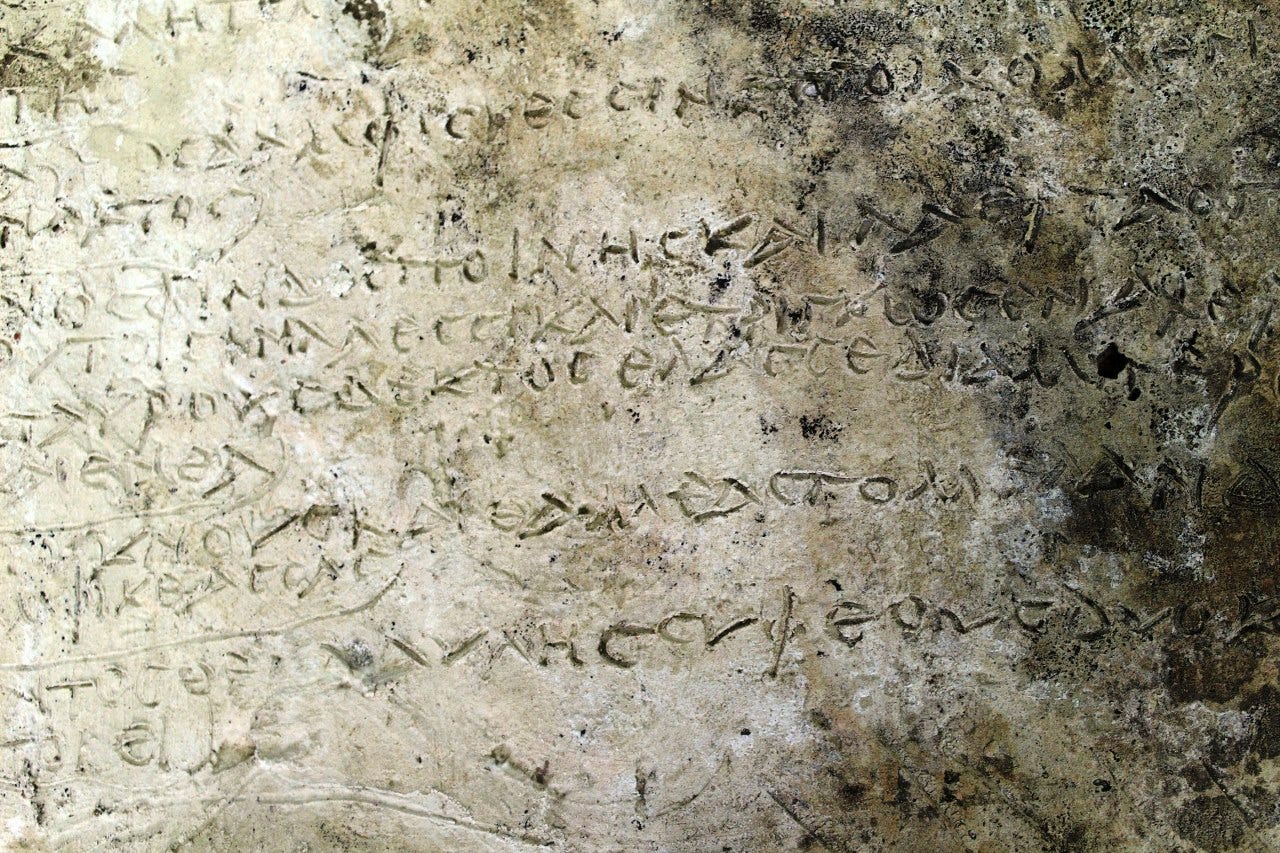
Around the 7th or 8th century B.C., Greece’s oral custom of extemporaneous performance moved into a written tradition of stable texts. Parry imagined how it happened: “I even figure to myself, just now, the moment when the author of ‘The Odyssey’ sat and dictated his song, while another, with writing materials, wrote it down, verse by verse.”
It hardly matters whether the singer or the scribe was called “Homer.” The striking truth is that the origin story of “The Iliad” and “The Odyssey” involves unlettered creators.
As he published his findings, Parry secured his reputation. One scholar even called him “the Darwin of Homeric Studies.” Yet Parry didn’t have much time to bask in his fame. In 1935, at 33, he died from a gunshot wound in a hotel room in Los Angeles. The police concluded it was an accident. Others have suspected suicide or even that his wife murdered him. Nobody knows for sure.
Parry’s assistant, Albert B. Lord, continued his mentor’s work. In “The Singer of Tales,” his 1960 book, Lord described how a society with mass literacy can struggle to appreciate its auditory roots. “Our real difficulty arises from the fact that, unlike the oral poet, we are not accustomed to thinking in terms of fluidity,” he wrote. “It seems to us necessary to construct an ideal text or to seek an original, and we remain dissatisfied with an ever-changing phenomenon.”
Mr. Nolan’s movie may force us to think about the fluidity of ageless stories and the dynamism of traditions. “The Odyssey” shapeshifts each time a translator puts out a new edition, as Daniel Mendelsohn did last year and Emily Wilson did in 2017. It evolves with each new retelling in the form of novels such as “Ulysses” by James Joyce and “Cold Mountain” by Charles Frazier, and movies such as “O Brother, Where Art Thou?” As Mr. Nolan adapts the poem to the most popular medium of his time, he is the latest in a long line of change agents.
Critics are already debating how well he’s done. Whatever his success, Mr. Nolan is true to his source in the most fundamental of ways. The first adapter of “The Odyssey,” after all, was Homer, whoever he was.
Mr. Miller is a Free Expression columnist at WSJ Opinion.
 | A guest post by
|