


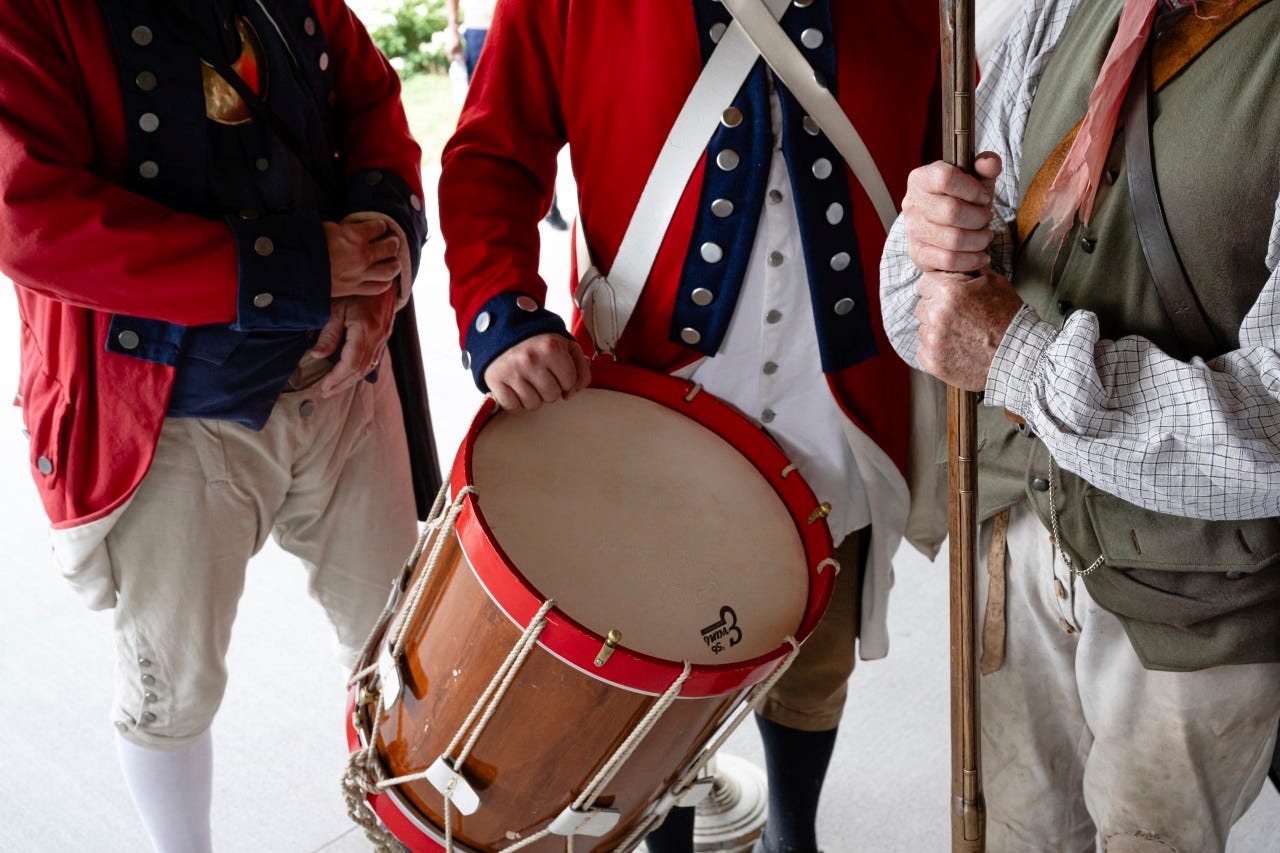
The Fourth of July has come and gone, but let’s keep America’s 250th birthday party going. My unofficial contribution to the festivities was teaching a week-long course in July for the Hertog Foundation, where I am a board member and adviser. The subject was conservatism and revolution.
The seminar examined the conservative response to the American, French and Bolshevik revolutions. I’d like to think that after five days of close reading and discussion my students came away with a better sense of what made the American Revolution a success and the American experiment special. I certainly did.
At first blush, the American Revolution poses a problem for conservatives. For one thing, it took place in 1775-83, years before the French Revolution of 1789 introduced the concepts of “left” and “right,” radical and conservative, into the political vernacular. For another, American conservatives find themselves in the paradoxical situation of defending a revolutionary heritage.
Some of the difficulties are resolved if you interpret the American Revolution not as a battle between left and right, as we understand those terms today, but as a fight between patriots and loyalists—with the patriots arguing for, fighting for and achieving independence from the British superpower.
Thus, men such as Thomas Paine and John Adams, who would travel different paths, nonetheless agreed on the principle of no taxation without representation and the broader philosophy of individual natural rights. And a figure such as Edmund Burke, the Anglo-Irish statesman known as the father of modern conservatism, called for compromise with America before condemning revolution in France.
Indeed, Burke’s remarkable “Speech on Conciliation with the Colonies” (1775), reads as an early brief for American exceptionalism. The British Parliament, Burke said, was responsible for the trans-Atlantic crisis because it ignored Americans’ distinctive traits.
Burke identified six qualities that made the colonies unique. Since the colonists were almost entirely descended from Englishmen, Burke said, they shared an English love of liberty and hatred of taxation. Moreover, the colonists had their own tradition of popular government. The colonists’ Protestant religion—what Burke called “the dissidence of dissent”—emphasized individual conscience and personal freedom.
Legal education was widespread in America. And Burke noted the great distance between the colonies and the mother country. “Three thousand miles of ocean lie between you and them,” Burke warned. “No contrivance can prevent the effect of this distance in weakening government.”
What’s fascinating about Burke’s argument for conciliation is how it anticipates conservative objections to future revolutions. The same values Americans defended in their revolution would be threatened by later upheavals. American conservatives wouldn’t abandon their belief in the God-given equal freedom of human beings, but they would join Burke and other British and European conservatives in opposing the French and Bolshevik revolutions.
Why? Because the French Jacobins and Russian communists suppressed religion while expanding centralized government.
For instance, when Alexander Hamilton called the French Revolution a “disgusting spectacle” in 1798, he zeroed in on its anticlericalism. By fighting the Catholic Church, establishing a new calendar and creating a festival celebrating the “Goddess of Reason,” Hamilton said, the revolutionaries were involved in “a conspiracy to establish Atheism on the ruins of Christianity—to deprive mankind of its best consolations and most animating hopes—and to make a gloomy desert of the universe.”
Similarly, American conservatives who opposed the Bolshevik Revolution grounded their strongest claims against communism in faith. In his “Letter to My Children” that opens “Witness” (1952), the anticommunist hero Whittaker Chambers defined the struggle with communism in explicitly religious language. “The Communist vision,” he wrote, “is the vision of Man without God. It is the vision of man’s mind displacing God as the creative intelligence of the world.”
For these authors, religion is important not only because it is true, but because its codes and rituals constrain immoral behavior. “Morality must fall with religion,” Hamilton wrote. As George Washington remarked in his “Farewell Address” (1796), “Whatever may be conceded to the influence of refined education on minds of peculiar structure, reason and experience both forbid us to expect that national morality can prevail in exclusion of religious principle.”
Conservatives see public morality as necessary for political freedom. Eighteenth-century conservatives worried that an irreligious and immoral people lacked guardrails against despotism. In such circumstances only a tyrant would be able to enforce order. “Society cannot exist unless a controlling power upon will and appetite be placed somewhere, and the less of it there is within, the more there must be without,” Burke wrote in his “Letter to a Member of the National Assembly” (1791).
To Chambers, communist ideology is an invitation to hubris. The promise of communism, he wrote, “was whispered in the first days of the Creation under the Tree of the Knowledge of Good and Evil: ‘Ye shall be as gods.’” The communist imagines himself to possess godlike powers of remaking the world, Chambers said. His inflated sense of self-worth leads him to centralize power. It tempts him to spread the revolution abroad. It gulls him into treating people as nothing but means to revolutionary ends.
The American answer to hostility to religion and intrusive government was decentralized power. “Divide your power so that every part of it may at all times be used for your advantage, but in such a manner, that your rights may never depend up on the will of any one man or body of men,” John Quincy Adams wrote in “Letters of Publicola” (1791).
The U.S. Constitution divides power horizontally across the three branches of government, including within the legislature. And the Constitution divides power vertically between the federal government and the states. The First Amendment prohibits both the establishment of religion and laws preventing its free exercise. No wonder contemporary revolutionaries—the American millennial and Gen Z socialists that Sen. John Kennedy calls “Lulu Lenins”—are so eager to revamp the Constitution. It’s the ultimate obstacle to their radical designs.
From the beginning, then, America’s revolutionary project in self-government was inoculated against the fevers that would consume other revolutions in bloodshed and tyranny. If that isn’t cause for celebration, what is?
Mr. Continetti is a Free Expression columnist at WSJ Opinion.
