

Iran’s Regime Is the Problem
If President Trump wants to win this war, he must deliver crippling blows to the Islamic Republic’s government.

Free Expression is a daily newsletter on American life, politics and culture from the Opinion pages of The Wall Street Journal. Sign up and start reading Free Expression today.
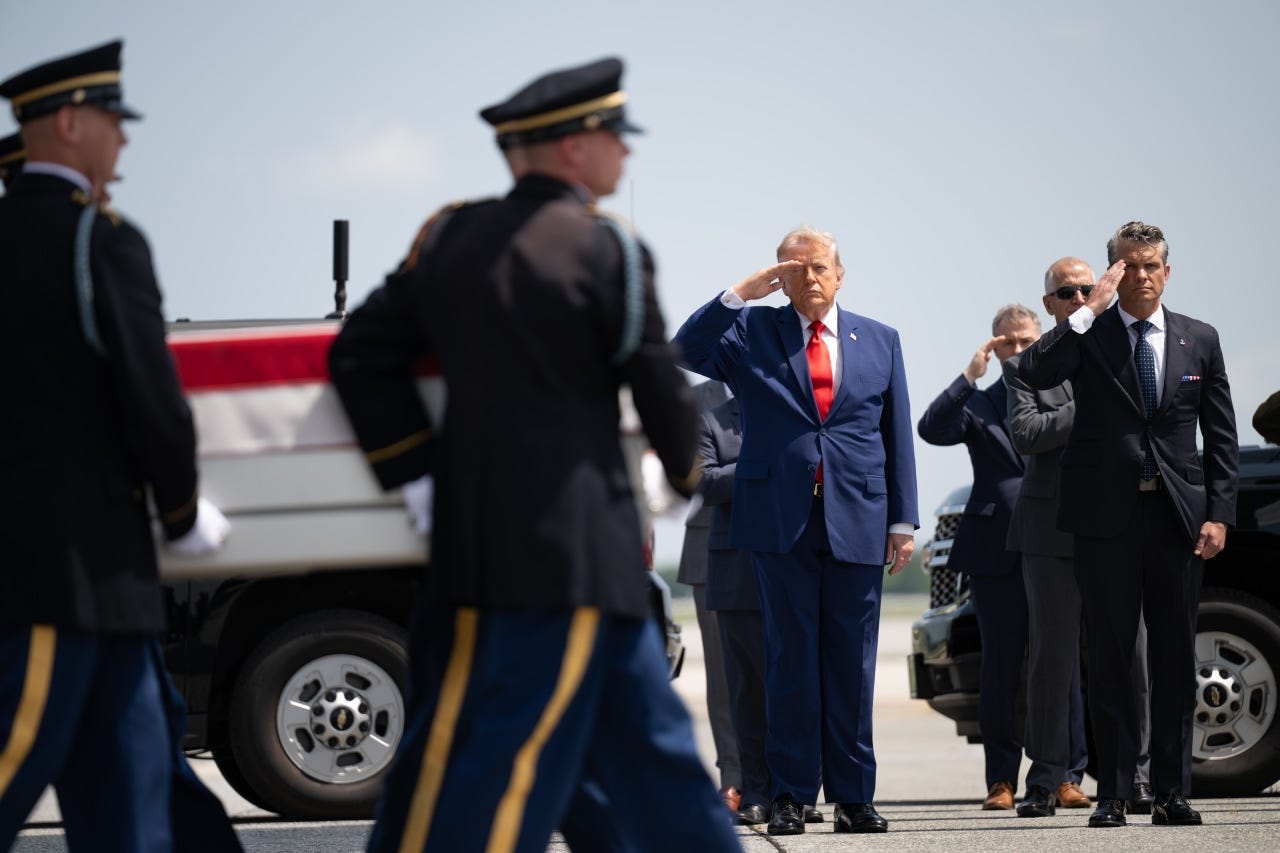
As he traveled to Dover, Del., Wednesday for the dignified transfer of three U.S. servicemembers killed in Jordan, President Trump sent a warning to the Iranian regime. In fact, he sent two. Success depends on which threat Mr. Trump acts upon.
Mr. Trump may continue the path he’s been traveling for months: a low-intensity conflict with Iran over the Strait of Hormuz that has no end in sight. Or he can break out of this self-imposed limbo by returning to major combat operations and targeting Islamic Revolutionary Guard leadership, command and control, propaganda networks and economic infrastructure. Only the second option makes sense.
“From this point forward,” Mr. Trump posted on Truth Social, “any time the Islamic Republic of Iran shoots at a ship in the Strait of Hormuz, whether it be by Missile, Rocket, Drone, or any other device or weapon, the United States will bomb and destroy ONE BRIDGE OR POWER PLANT, including those located next to, or in, the Capital City of Tehran.”
Four hours later, Mr. Trump posted a screen cap of a news article headlined, “Trump orders CENTCOM to ‘open the gates of hell’ after US troops killed, launches strikes on Iran.”
Notice the difference. The first post threatens tit-for-tat retaliation: one destroyed bridge or energy facility for every Iranian attack on maritime traffic in the strait. The response would be proportional. There would be continued signals toward a diplomatic off-ramp.
The second post is expansive. Opening the gates of hell isn’t a run-of-the-mill activity. It isn’t limited in scope. It’s all-out war—using overwhelming force to defeat the enemy. No hesitation. No waffling.
Operation Epic Fury began on Feb. 28 with this sense of purpose. Mr. Trump vowed to deny Iran nukes, destroy its navy, missiles and missile industry, defang its terrorist proxies and give the Iranian people a chance to overthrow the mullahs.
Simultaneously, Israel launched Operation Roaring Lion. In the opening minute, 40 Iranian leaders were killed, including Ayatollah Ali Khamenei. The combined operation cost U.S. and Israeli lives. It raised energy and commodity prices. It was unpopular. But it was on track to achieve Mr. Trump’s stated objectives.
Then Mr. Trump began a controlled experiment in proportional retaliation. He announced a cease-fire on April 7. The pause, he wrote, was “subject to the COMPLETE, IMMEDIATE, and SAFE OPENING of the Strait of Hormuz.” Iran never opened the strait. But Mr. Trump extended the cease-fire. To punish Iran for holding the strait hostage, he imposed a naval blockade of Iranian ports on April 13. Then he followed the logic of proportionality—the logic of serve-and-volley, of what Mr. Trump calls “love taps.”
Mr. Trump slowly tapped his way up the escalatory ladder. The U.S. traded fire with Iran whenever the mullahs attacked shipping or Gulf allies. But America’s response was limited. The idea was that restraint would create space for diplomacy.
Vice President JD Vance and envoys Steve Witkoff and Jared Kushner negotiated with Iran’s politicians. On June 17, Mr. Trump and Iranian President Masoud Pezeshkian signed a memorandum of understanding: In exchange for opening the Strait of Hormuz, America would end the blockade of Iranian ports and allow the Islamic Republic to sell oil. The MOU promised even more lucrative rewards if Iran bargained over its nuclear program.
What did Iran do? It fired on commercial vessels and neighboring countries. It plotted to assassinate Mr. Trump. It moved centrifuges deep underground in Pickaxe Mountain. It targeted a U.S. base in Jordan, bringing U.S. combat deaths to 18. Hundreds more have been wounded.
Restraint and diplomacy failed. Hence Mr. Trump’s change in tone. He has said the MOU is “over” and called the Iranian leadership “scum.” He’s pledged that Iran will pay for killing U.S. troops, that Iran will never have nukes and that the Strait of Hormuz will be open for all. He reimposed the U.S. blockade and sanctions. He’s broadened the scope of U.S. strikes in Iran to include bridges, refineries and factories. He speaks of worse to come.
Yet on the central question—a return to full-scale kinetic action—Mr. Trump is ambiguous. Look at his dueling Truths. Why hasn’t he decided on a course of action? Perhaps Mr. Trump is content to play out the current dynamic, with its ongoing, low-level bombing and renewed blockade choking off Iran’s economic lifeline. Perhaps he’s worried that full-scale air- and missile-war, with potential for special operations forces on the ground, will mean more dead and wounded, higher prices, further damage to the Gulf states and possible unrest in Kuwait and Jordan.
Reasonable concerns. But they must be weighed against the price of current policy, against the prospect of Iran closing the strait at will, fueling terrorism and resuming its nuclear program. By now, Mr. Trump must understand that Iran isn’t interested in diplomacy. The Islamic Republic remains what it has been for 47 years: a fanatical terrorist regime with plans to export its revolution, build a nuclear weapon, destroy the state of Israel and dominate the Middle East. Iran hasn’t changed its behavior. It hasn’t seen the light.
Why? Because the status quo favors the regime. It remains in power. It has deterred Arab powers from joining the fight. It doesn’t have to worry about Israel (for the moment). It’s standing up to the Great Satan. All it needs to do is wait out the clock.
Mr. Trump’s problem is the regime. It has always been the regime.
If he wants to win this war, Mr. Trump must deliver crippling blows to Iran’s government. That means rejecting proportionality and ordering Centcom to resume pursuing its target list as of April 7. It means expanding targets to include highways, bridges, factories and other infrastructure that sustains the IRGC war machine—not one a day, but all at once. It means making Brig. Gen. Ahmad Vahidi, the IRGC commander, and other regime bigwigs continually look over their shoulders. And it means impairing the Islamic Republic’s ability to spew propaganda—shutting off state TV, permanently.
Opening the Strait of Hormuz, eliminating the Iranian nuclear program and debilitating the IRGC’s missile production lines can’t be done diplomatically. President Trump started the war convinced that victory requires resolve, commitment and the application of necessary means to achieve a given end. What’s happened since April proves as much. Time to act like it.
Mr. Continetti is a Free Expression columnist at WSJ Opinion.
 | A guest post by
|
Islam itself is the problem and its' worldwide, not just the Shia maniacs in Iran! The Islamic cult is 100% incompatible with Western Civilization.
It would be a good bet that the IRGC leadership is not meeting altogether in the same room anytime soon.