

King for a Day
The British monarch’s visit to Washington was a delightful reprieve from all the partisan bickering.

Free Expression is a daily newsletter on American life, politics and culture from the Opinion pages of The Wall Street Journal. Sign up and start reading Free Expression today.
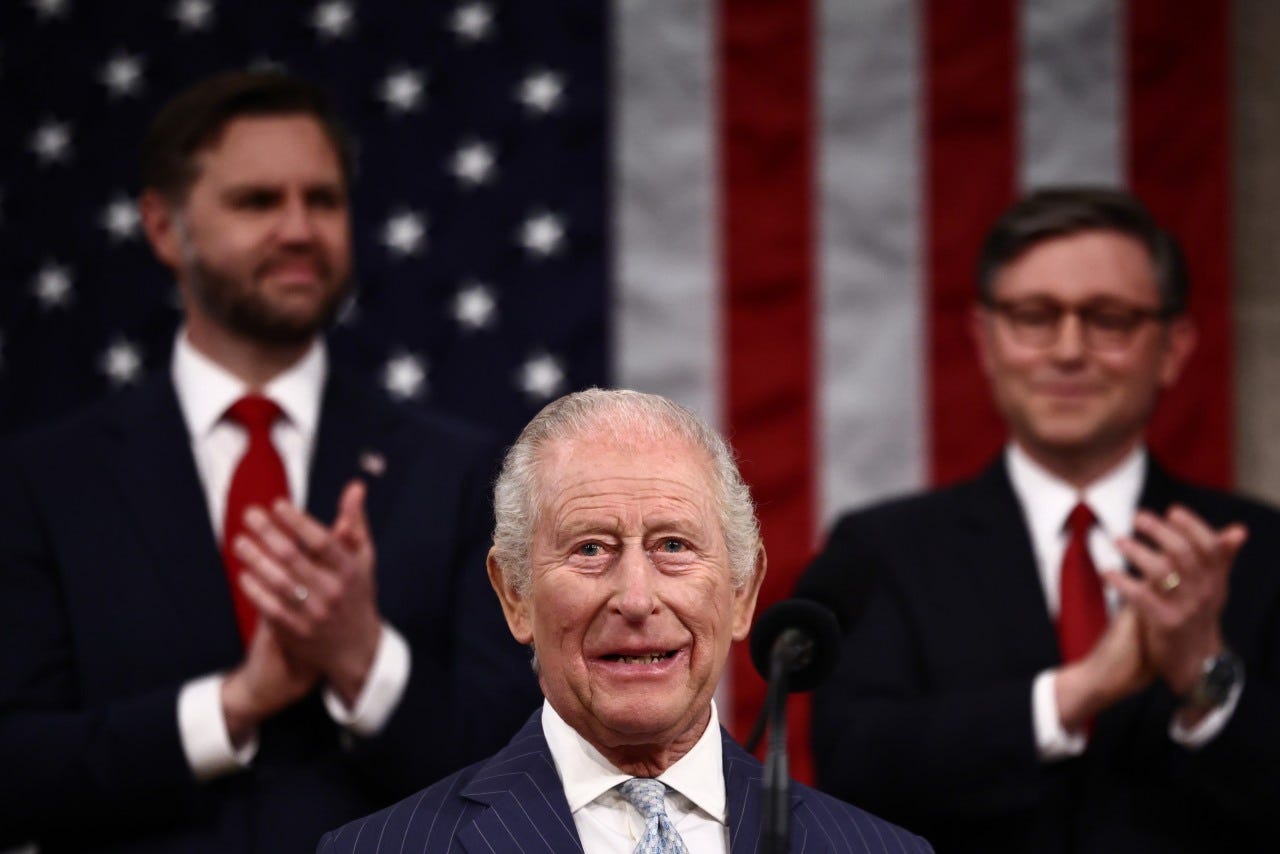
The scene on C-Span on Tuesday was like a happy, surreal inversion of the State of the Union. King Charles III and Queen Camilla walked down the aisle in the House chamber, just as the president does when he comes to address Congress. Cheering lawmakers looked thrilled and starstruck. House Speaker Mike Johnson beamed.
The reception was sincere. Perhaps only the king—an innocuous old man with no partisan political power—could preach so effectively, and to warm bipartisan response, a distilled defense of our founding values. “Our nations are, in fact, instinctively like-minded,” he said, “a product of the common democratic, legal and social traditions in which our governance is rooted to this day.” That includes “the revolutionary idea of life, liberty, and the pursuit of happiness,” ideas from “the British Enlightenment,” and “ideals which had an even deeper history in English common law and Magna Carta.”
The Magna Carta, he noted, has been cited by the U.S. Supreme Court “not least as the foundation of the principle that executive power is subject to checks and balances.” That sounded like it could be a pointed comment, and I half-expected Republicans to raise their eyebrows. But members of both parties stood and cheered.
The king spoke about the “rule of law” and “the certainty of stable and accessible rules,” an important reminder to those more concerned with getting their preferred policy outcomes from our courts. These “created the conditions” for “unmatched economic growth,” he said.
The king spoke of the importance of religion and the Christian faith in particular, calling it “a firm anchor and daily inspiration that guides us not only personally, but together as members of our community.” The king also defended the liberal national order and “moments that have defined our shared security.” He called for supporting Ukraine, and spoke of the importance of the North Atlantic Treaty Organization. He spoke of 9/11, which “shall never be forgotten.”
The king was refreshingly forthright about American greatness. The Founding Fathers were “bold and imaginative rebels,” he said. “America’s words carry weight and meaning, as they have since independence. The actions of this great nation matter even more.”
Progressives have long despised America and what it stands for, quick to grovel to other countries and complain about our sins. A faction with loud voices on the right, too, is increasingly anti-American, calling out the liberal order for failing them. They fawn over dictatorships and sometimes socialism.
That’s an error of forgetfulness. Many Americans forget 9/11, and we forget the ideas that gave us the freedoms we have. But King Charles wasn’t the first British monarch to cross the ocean and remind us. “We, like you, are staunch believers in the freedom of the individual and the rule of a fair and just law,” Queen Elizabeth II told Congress in 1991. “They are the bedrock of the Western world.”
As the king said, the U.S.-U.K. relationship isn’t built on “sentiment.” It is strategic. King George VI, the first reigning British monarch to visit the U.S., came to shore up the alliance as World War II was brewing. King Charles’s visit is intended to patch up frayed relationships among the countries’ political leaders due to the war with Iran.
The countries’ relationship has been strategic yet sincere from the beginning. In 1776 the American rebels knew they were fighting for shared liberal ideals. But those ideals led to concrete and tangible social benefits. John Adams, the first U.S. ambassador to Great Britain, met King George III for the first time in London in 1785. He told his majesty of his desire to restore “the old good nature and the old good humor between people who, though separated by an ocean and under different governments, have the same language, a similar religion, and kindred blood.”
The king was “much affected,” Adams wrote.
Ms. Ault is an assistant editorial page writer at the Journal.
 | A guest post by
|