

Milton Friedman Was Right
Critics of the famed free-market economist should try learning from him.

Free Expression is a daily newsletter on American life, politics and culture from the Opinion pages of The Wall Street Journal. Sign up and start reading Free Expression today.
Milton Friedman died two decades ago, but it seems like he’s been in the news every day. Inflation, tariffs, rent controls, price controls—the issues that dominated his age have returned in ours. Prominent Democrats and Republicans attack Friedman’s record while proving his case. They’re busy exorcising Friedman’s ghost when they ought to be reviving his spirit.
Friedman stood 5 feet tall. Yet he looms menacingly in the imagination of anyone who would use government power to plan, control, regulate and redistribute. For example, as a candidate for president in 2020, Joe Biden told Politico, “I think there’s going to be a willingness to fix some of the institutional inequities that have existed for a long time. Milton Friedman isn’t running the show anymore.”
Instead, Mr. Biden ran the show—and delivered the worst inflation in 40 years.
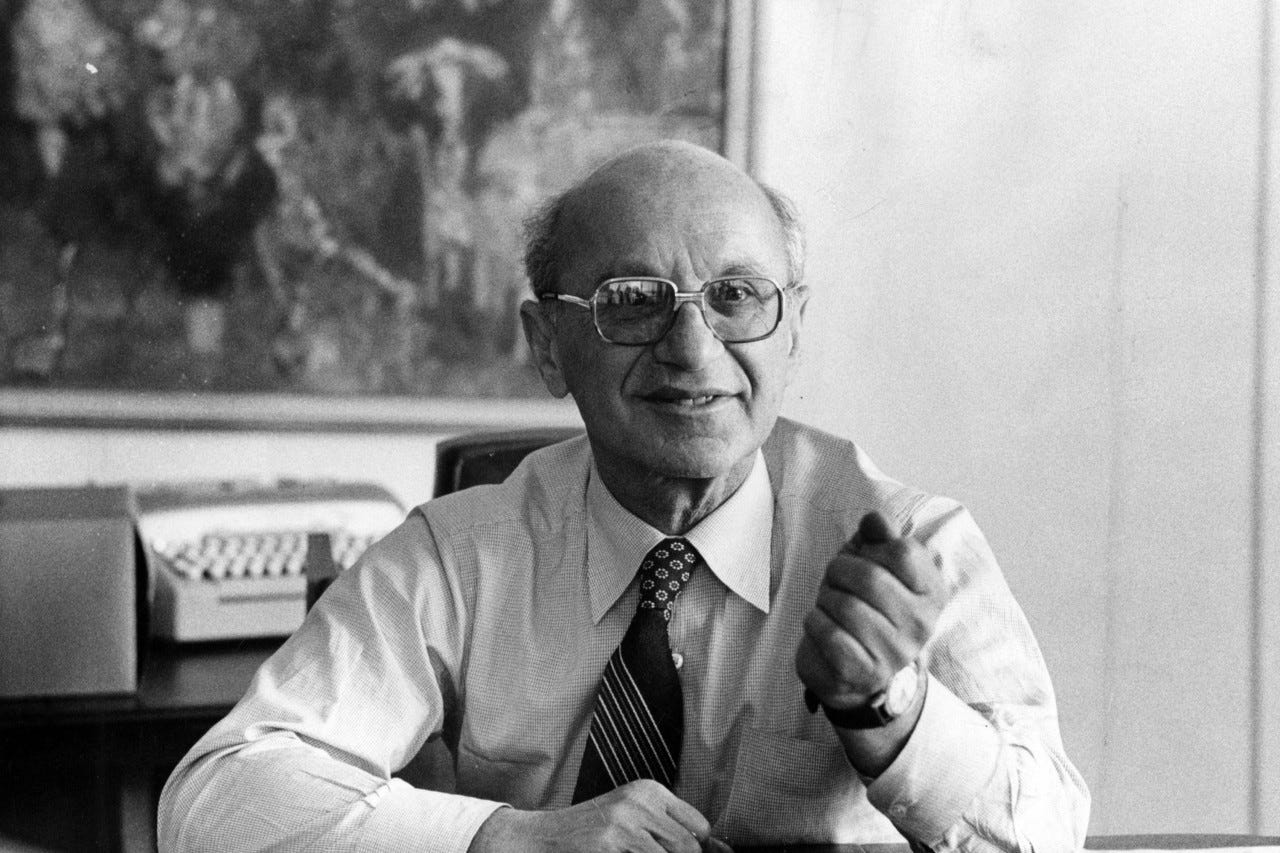
Friedman’s modern critics are fighting a cartoon. They have a false image of Friedman as a coldhearted, abstract theorist, a man who reduced human beings to units of production, relationships to transactions, nations to free trade zones. This is a strange way to describe a brilliant, impish and quizzical researcher and professor.
The real Milton Friedman taught for many years at the University of Chicago and won the Nobel Prize in Economics in 1976. But what made Friedman special—and continues to bother politicians with grand designs for remaking the world—was that he was no mere academic. He brought the principles of choice and competition down from the ivory tower and into daily practice: most successfully, and prominently, in promoting educational freedom. As Friedman predicted, “If present public expenditures on schooling were made available to parents regardless of where they send their children, a wide variety of schools would spring up to meet the demand.”
Even more troubling for advocates of centralized power, Friedman was a master popularizer. Such books as “Capitalism and Freedom” (1962), “A Monetary History of the United States, 1867-1960” (1963), coauthored with Anna Schwartz, and “Free to Choose: A Personal Statement” (1980), written with his wife Rose, revolutionized the study of monetary policy and breathed new energy into the philosophy of individual freedom.
Friedman adapted “Free to Choose” into a popular television series (aired, ironically, on PBS) and wrote a long-running column in Newsweek magazine. He was magnetic and compelling and remains so. That’s why clips of his speeches and debates continue to circulate on X, YouTube, Instagram and TikTok.
Not everyone is pleased. New York’s socialist Mayor Zohran Mamdani hasn’t gone after Friedman directly, preferring to train his rhetorical fire on Ronald Reagan. But there’s no question Mr. Mamdani would rebuke Friedman if given the chance.
“We will replace the frigidity of rugged individualism with the warmth of collectivism,” Mr. Mamdani announced in his January inaugural address. He’s been turning up the heat ever since: rent freezes, tax hikes, government-run grocery stores and public lists of homeowners he finds undesirable.
Critiquing Friedman is a bipartisan trend. Recently, Vice President JD Vance told the Daily Wire’s Michael Knowles that, “American economic policy on the right is now much more Alexander Hamilton than it is Milton Friedman. I think that’s obviously a good thing.”
Obviously?
Leave aside the fact that current economic policy is neither Hamilton’s nor Friedman’s—it’s President Trump’s. Concentrate instead on the policy’s ambiguous results. Inflation remains above the Federal Reserve’s 2% target. Real wage growth has been lackluster. Overall manufacturing employment is down since January 2025. Furthermore, Mr. Trump’s economic agenda is unpopular. The public rejects tariffs.
It gives Mr. Trump poor marks on the economy and inflation. If this is the alternative to Friedman, it isn’t working.
Mr. Vance also told Mr. Knowles that, “Milton Friedman’s ideas made more sense in the 1980s because they were being advocated in a country that still had a very rich and powerful institutional Christianity.” Yet Friedman’s ideas—that government should secure rights and allow free people to trade with minimal interference—make sense regardless of social or historical context. They’re based on empirical data and the law of supply and demand. A rich and powerful institutional Christianity wasn’t behind Hong Kong’s or India’s prosperity, for instance. Their growth was the result of falling barriers to savings, investment and trade.
True, Friedman had little to say about culture. For him, people and nongovernmental associations such as families, churches and communities were the best transmitters of moral values. But his lack of interest in social questions doesn’t undermine his insights into economics. And no one is asking policymakers to become die-hard libertarians. Just a little Friedman would go a long way.
Friedman’s strange afterlife—strawman to statists and authoritative voice for champions of freedom—speaks to his outsize role in the political conversation. No one replaced him as a singular advocate for free markets, free enterprise and individual responsibility. No one has improved on his arguments for sound money, limited government, school choice and allowing markets not bureaucrats to set wages and prices. No one has captured his clarity, force and doggedness.
To defeat socialism, intellectual and political leaders will have to draw on Friedman’s lessons. They’ll have to emulate his feistiness, his love of the fray. And they’ll have to point to facts, not caricatures. Otherwise, those who lambaste Friedman will repeat the mistakes of past governments. His specter will haunt statists of all parties. And America will learn the hard way that Friedman was right once again.
Mr. Continetti is a Free Expression columnist at WSJ Opinion.
 | A guest post by
|