

By David Skinner
There’s something pleasantly awkward about renting a car. It’s like a blind date, but with an automobile. Will we end up going steady?
Oh, definitely not, I thought after a weekend drive into the Poconos. I had rented an electric vehicle. Now I may never look at EVs the same way again.
I had long wanted to take an EV, any EV, for a spin. Noticing the price difference between the cars with internal-combustion engines and EVs on the rental website, I thought, “Why not now?”
I have also been experimenting with AI assistance, so I ran my plan by Claude, which agreed that, given my route, this would be a low-stakes way to try something new. Which reminds me, Claude, we need to talk.
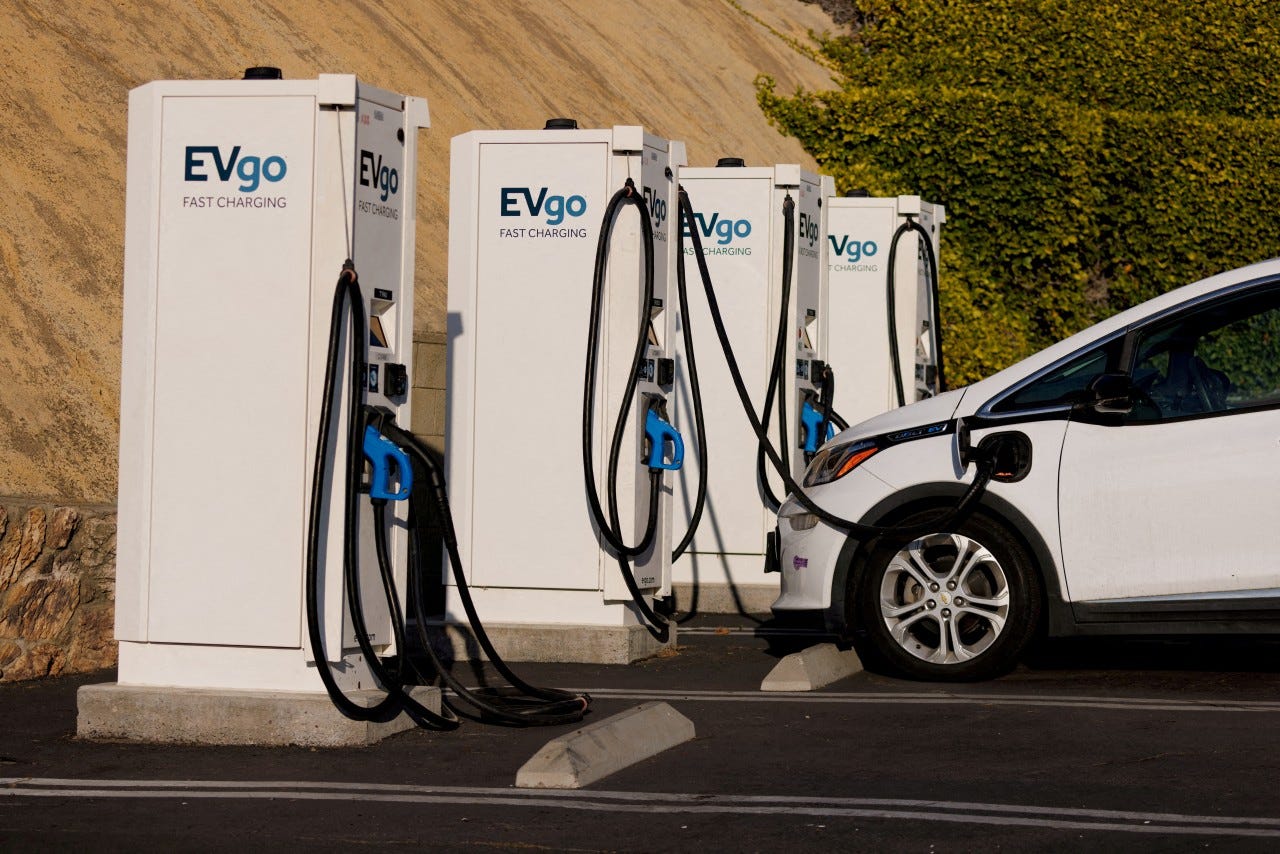
Instead of the Ford E-Mach I thought I was getting, the car waiting for me at Newark Airport was a Chevy Bolt. The rental agency classifies the Bolt as a “cool” car—that’s its actual internal classification. I had been anticipating a frictionless futurist joyride, but circling out of the parking lot’s spiral exit I noticed the steering required a lot of pressure—like from the days before power steering, when your arms did the actual work of forcing the front wheels to turn.
Acceleration was fine, impressive even, but when my speed exceeded 50 miles an hour, a dinging noise started and a message on the dashboard alerted me that I was speeding. But I wasn’t speeding. The posted limit was 65. And something must be said against back-seat driving, whether human or not, while you are merging with highway traffic—something like, Shut up, I am trying not to get killed here.
Claude said I would be able to drive to my destination and back without needing a mid-trip recharge, but there were plenty of charging spots along most of the route. Claude was wrong on the first part, and I should have been paying more attention to the second part. After about two hours of driving, I turned north and noticed my battery power was declining fast. With about 25 miles to go, I pulled over to look for a place where I could top up.
In theory I had enough juice to get to my destination and onward to a station where I could recharge, but I was worried about the up-and-down driving ahead as I entered the hilly Poconos region. If I started burning through battery power at a greater rate than I had so far, I could be cutting it close. To be on the safe side, I looked for and, after some harried effort, found a place to charge. It was in a crowded hotel parking lot.
I had to download an app, which I hate having to do, and type in my credit card number, but after several tries, I got the thing to work. Ah, success, but then I noticed how slowly the battery was charging. After 22 minutes, it had restored only 6% of the battery’s charge. I gave up. Comically inefficient, it was also inconvenient.
My hoped-for 10 p.m. arrival came in closer to midnight, what with looking for a place to charge the battery, the first-time hassles of charging, and then the very slow charging itself. But on Sunday I was better prepared for the drive back.
This time I knew exactly where the nearest fast-charging station was, and I had located another one close to Newark Airport, where I could recharge before returning the vehicle. But driving to the first charging station took me 15 miles in the wrong direction and “fast” charging to above 80% still took close to an hour. The second stop near the airport took more than 45 minutes. With the additional driving time, I easily spent more than two hours charging the car for a round trip of roughly six hours—not counting the time spent charging on Friday night.
Just as I was late to my friend’s lake house, so was I late to return the rental car, which cost me an extra $35, erasing most of the savings of choosing an EV in the first place. And I am left to wonder: Were these cars this bad the whole time?
Maybe it’s the presence of Dr. Fauci in the news, but I can’t help but wonder if EVs were one of those things we were all supposed to get behind while obediently ignoring the utter crapitude in front of us.
I’m sure my blind date with this EV could have gone better: Inexperience and user error did cause some of my delays. A fancier EV would have performed better, I’m sure.
But it’s also clear that choosing an EV had come at the cost of what I was driving for. The environmentally respectable option made me late to see my friends and early to leave them. This is progress?
I vaguely remember reading about a man who, when returning home, would always take a different combination of roads. He did so on the theory that there was always something new to learn. Of course, a new route can disappoint, but in the worse-case scenario you still learn something valuable: never to go that way again.
Mr. Skinner is the Journal’s deputy editorial features editor.
I've been driving an EV for 15 years (actually several successive EVs). EVs have many advantages, like being very quiet, and acceleration is very smooth. And they are fine for driving around town, especially if you have a Level 2 charging station (220V) at home. But going out of town requires careful planning and a bit of luck. And the battery does deteriorate, which is why I keep swapping them out before they reach 100,000 miles. And definitely don't let it be the only car in the household. You need at least one car that can be filled up at a gas station.
I know a Tesla owner who is also a former employee of Tesla; he purchased the EV at an employee discount. He is very happy with the car when it comes to driving around town and recharging it in the garage over night. Long distance driving, however, is a pain, precisely because of the time it takes for charging which might include waiting for an available charger. However, I should also add that the stock options this person acquired during his years with the company have cushioned any inconvenience he has sustained with the vehicle.