


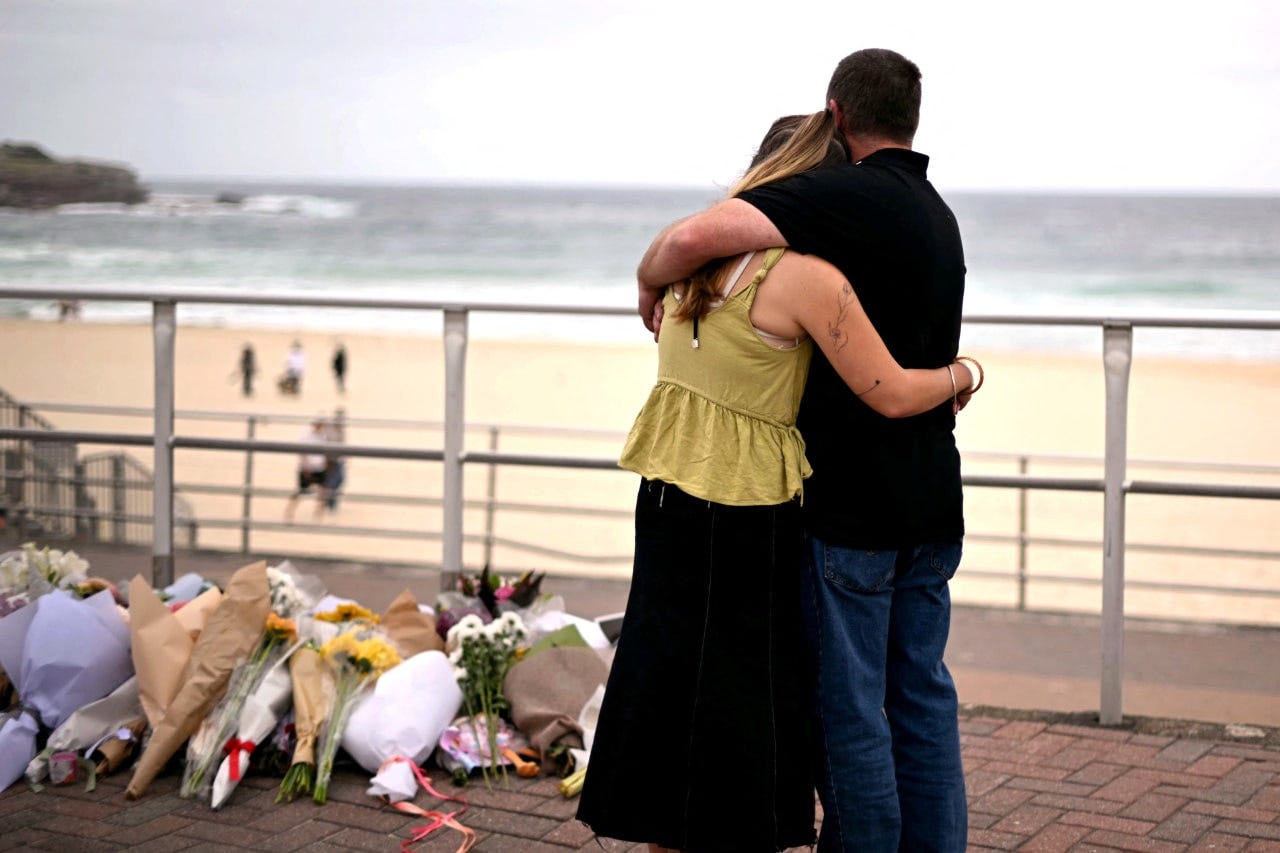
Sydney’s Bondi Beach has been known for more than a century as “the playground of the Pacific.” Early morning run clubs and beach yoga classes attract the trim, taut and terrific of Australia’s youth, and houses in this affluent part of the city are among the most expensive in the country. When the news broke on Sunday, my Australian father messaged me to say that there had been a terrorist attack “in Bondi, of all places.” The nation’s most famous playground is now famous for something very different.
With hindsight, we can understand this attack as the culmination of a series of sinister events. As well as being a suburb associated with sunshine and surf, Bondi is also a center of Jewish life in Sydney, with a concentration of synagogues and kosher shops. In recent years, antisemitic attacks have occurred with increasing frequency in Australia, including an arson attack in Bondi last year. The Australian Jewish community has been asking the government for protection in tones of mounting urgency.
In September, a clash between pro-Palestine and pro-Israel groups on Bondi Beach turned violent. Days later, protester Ehtesham Ahmad rode a horse onto the sand and galloped around waving a large Palestinian flag. “If I do it in Bondi, it gets the headlines,” he told an Australian news channel. He understood—correctly—that marking one’s territory on the beach has a special power in Australia.
Sydney’s beaches have been the scene of interethnic violence before. In the early 2000s, Sydney residents endured a wave of gang rapes perpetrated by Muslim men of Lebanese and Pakistani descent against white and indigenous teenage girls. For several years, reports also circulated of violence and intimidation committed by groups of Lebanese youths on Sydney’s beaches.
Escalating ethnic tension reached its climax in 2005 when a Lebanese gang got into an argument with a pair of female off-duty lifeguards on North Cronulla beach in Sydney. The women accused the men of staring at them. One of the men told the women to “f— off and leave our beach.” Two male lifeguards who intervened were attacked and one was seriously injured. This incident triggered what have come to be known as the “Cronulla race riots.”
Who owns the beach? This isn’t a trivial matter in the eyes of Australians, for whom the beach functions as a commons—a beautiful, accessible, shared resource that is often said to symbolize Australia’s egalitarian and happy-go-lucky culture.
For a sectarian group to make a claim on the beach—whether through flag waving, intimidation of lifeguards or terrorism—disturbs and angers Australians to a degree that may surprise people who don’t know the country well. Many Australians, both Jewish and non-Jewish, are this week coming to terms with the fact that the beach is no longer a sanctuary. The evident vulnerability of the Australian beach is an indication of the vulnerability, not just of Australian culture, but of Western culture writ large. We have all been lucky in ways that we don’t even realize. Now, it seems, our luck is running out.
Strange as it may seem to those of us who have grown up with beach holidays and phrases like “life is a beach”—taken as shorthand for “life is good”—a love of the beach is actually unusual. For most of Western history, it was a fearful thing. Beaches were the site of shipwrecks, piracy and superstition. Medical authorities insisted that excessively salty sea air was a source of illness. It wasn’t until the 18th century that people came to believe in the health-giving properties of the seaside, but the water itself remained a focus of anxiety since most people didn’t know how to swim.
Before the 20th century, the sea was particularly off-putting for women, since they were expected to dress modestly at all times. Wading into the water in cumbersome clothing was both uncomfortable and dangerous. Drowning deaths were common, particularly when mothers who had never learned to swim entered the water fully-clothed while attempting to rescue their children.
Such tragedies still happen in Australia, where some immigrant groups are overrepresented among drowning deaths. People who have grown up in parts of the world with no beach culture will sometimes enter the sea in regular clothes, with no experience of swimming and with no idea of how treacherous the currents can be. A majority of people worldwide can’t swim, which is one reason why some Australian states offer free lessons to immigrants.
These swimming lessons have a symbolic importance, as well as a practical one. Beach culture represents the essence of the Australian dream. The country tasked the beach with building, in the words of a 1923 newspaper article, a “sturdy, athletic healthy race of young men and women.” Which meant, of course, that young Australians had to learn to swim. Starting in the late 19th century, schools were required to offer all students swimming education. Beach swimming came to be understood, says Steve Georgakis, a sports historian at the University of Sydney, as a “definer of what meant to be Australian.”
From the 1920s onward, women were also able to enjoy the beach while wearing practical swimwear that revealed almost as much skin as male beachgoers. One of the tasks of the Australian lifeguard—a much-loved cultural icon—is to enforce the social norms of the beach, including the norm that women ought to be able to wear swimsuits without fear of sexual harassment.
But that norm is now faltering. Australian social media abounds with complaints about Muslim men, in particular, behaving inappropriately toward women on the beach. In Muslim-majority countries, women aren’t permitted to dress in the way that Australian women are now used to. In a recent incident in Lebanon, for instance, a woman wearing a one-piece swimsuit on the beach, accompanied by her husband, was set upon by a crowd of angry men who surrounded the couple, flicking sand in their faces. In another recent incident, a British tourist on vacation in the Maldives was arrested for wearing a bikini, an act forbidden by the country’s Islamic legal code.
Here’s the thought that most troubles me. Australian beach culture relies on several social phenomena, all of them fragile: a nonsectarian commons that is freely accessible to everyone, regardless of ethnicity or religion; a culture that permits women to dress scantily without fear of harassment; and a tacit system of unwritten rules that maintain order on the beach, including respect for the authority of lifeguards who have no special legal powers and carry no weapons. None of these are the human default. All, in fact, are historically peculiar. The kind of high-trust society that can maintain a beach culture like Australia’s is a rare and precious thing.
We could easily lose it. Progressives across the Anglosphere evince a strange combination of two contradictory impulses: ostentatious generosity toward immigrants, combined with a profound parochialism. This paradox is a consequence of naiveté about what other cultures are actually like, particularly Muslim cultures that diverge radically from modern Western norms. American and Australian progressives alike are open to the rest of the world only because they assume that the rest of the world is really just like them. Step across our borders, they say, and you become one of us—eager to participate in the open society that we have created.
Come on in, the water’s fine.
It still hasn’t dawned on these idealists that their ideals are actually peculiar. Not everyone wants public spaces that mix sex, religion and ethnicity. Not everyone wants to be tolerant. Not everyone wants to uphold the values that have made Australian beach culture possible. The horror at Bondi Beach is now forcing Australia—the nation once dubbed “the lucky country”—to reckon with the costs of its complacency.
Ms. Perry is a Free Expression columnist at WSJ Opinion.

From my conversations, one core reason Australian Jews feel so betrayed by the state is this - a feeling of, “we upheld our end of the social contract.” We came to this country, integrated, wanted to be Australian, followed the laws, and contributed to society. Now, fast forward a few decades, and we’re being persecuted by a group, significant minorities of which refuse to uphold *their* end of the social contract - dominating rather than integrating, breaking laws and customs rather than following them - and the state is giving *them* special treatment and free rein to abuse us. It’s a betrayal at the heart of what it means to be an Australian.
Excellent summary, Louise. I would add to it that anger about this in the general community is now white hot. For far too long we have tolerated in our midst people who are violently antisemitic. Who want to import their alien ideologies and endless blood feuds here into our country. Australia is presently run by political cowards and midwits who have acted ineffectively or not at all. In years to come, this will be seen as a defining moment in our history. Will we continue to decline, as our parent country, Britain, has declined, or will we course correct and remember who we are supposed to be?