

One Ring to Heal Them All
Health trackers can quantify your sleep and activity, but a good life is about more than numbers.

Free Expression is a daily newsletter on American life, politics and culture from the Opinion pages of The Wall Street Journal. Sign up and start reading Free Expression today.
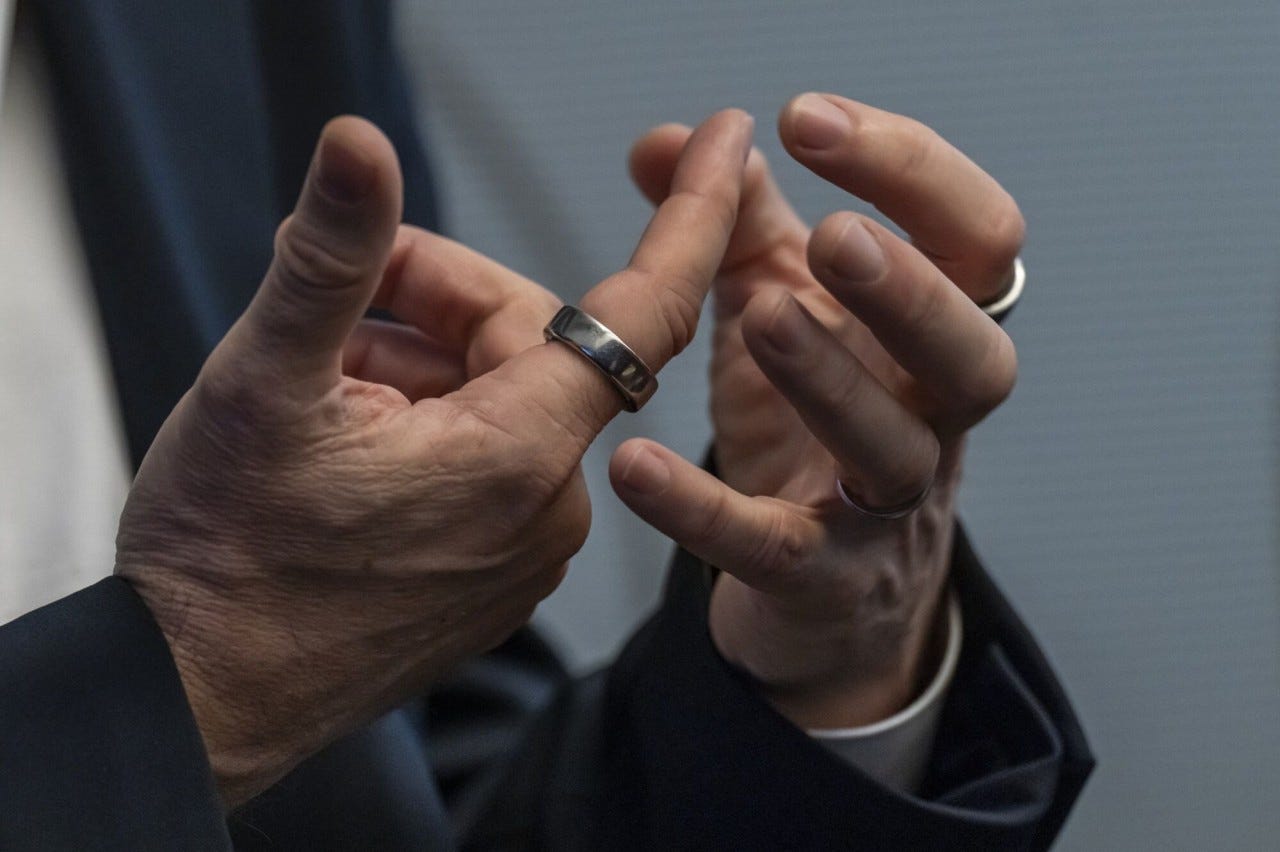
I’ve always been a night owl. A few years ago, I decided to try tracking my sleep with an Oura ring, a trendy gadget that measures the wearer’s hours of deep sleep, number of REM cycles, resting heart rate, body temperature, blood oxygen levels and myriad other functions. I thought it could be interesting, even fun, to quantify how I felt each morning. And as a journalist, I like data.
My sparkling little Oura ring produced plenty. When I achieved a high “sleep score” or “readiness score,” opening up the Oura app gave me a dopamine rush similar to getting likes on social media. When I didn’t get good numbers, it felt like a slap in the face. The ring quickly became an omnipotent narrator or a toxic boyfriend, dressed up in polished fonts and pretty graphics as it scrutinized my every choice. “You had one sip of alcohol last night? Oof, bad move,” it seemed to say. “Did you think you slept well? Actually, you didn’t.”
The device also kept a constant eye on my activity levels, cheering me on with alerts when I reached a certain step count or caloric burn: “Great job! Activity goal reached!” It scolded me on days when I was glued to my desk: “Time to stretch your legs,” it chimed after 50 minutes of inactivity. “Give me a break!” I wanted to scream back.
A growing body of literature suggests that constant health tracking can pose a problem of its own—the pursuit of perfect numbers, and the nagging awareness that you’re always falling short.
“What’s powerful about a tracker is that it prompts this automatic process of self-reflection,” said Rebecca Robbins, a sleep scientist at Boston’s Brigham and Women’s Hospital and a sleep expert at Oura. She notes that it can be a source of stress for people with a tendency toward perfectionism (relatable). Orthosomnia, or an unhealthy obsession with ideal sleep, can make insomnia worse. The harder you try to sleep, the harder it is to do it. “When we see perfectionism in sleep, it can often be almost a setup for failure.”
Those who wear health trackers frequently drink less when they see how even a single glass of wine crushes their health data. But do you need an app to tell you that you had a bad night’s sleep? You feel it in your bones. Besides, life is short; must we shame ourselves for moderate indulgences in its simple pleasures? I’d rather sit with the memories of the fun I had, than with the guilt of seeing how my heart-rate variability was suppressed or my readiness score hit the floor.
For some users, wearable fitness trackers function less as an impetus for positive behavioral change than as status symbols in the booming market for longevity and wellness products. Picture the girl who wears a matching workout outfit and a gold Oura ring, or the gym bro dressed in head-to-toe Nike with a Whoop on his wrist. For some it serves a different purpose: Some particularly social 20-something guys I know treat it as a point of pride if their recovery scores are in the single digits after a night out. It means they had a good time.
If we’re straining for more REM sleep and 10,000 steps a day solely for the sake of hitting certain benchmarks, and shaming ourselves when we don’t, we’ve lost sight of something essential. An occasional sleepless night or a slow-moving day are normal human experiences, and often signs that life’s got you busy, which isn’t necessarily a bad thing. As Ms. Robbins said, “Sleep is one health behavior where it’s not going to be perfect every night.”
Even those who do succeed in engineering their daily patterns to perfection shouldn’t expect lasting happiness as a result. A performance dashboard can’t measure something as glorious and elusive as that. I eventually decided to break up with my Oura ring. One day, I placed it on the charging stand, and never put it back on. It felt liberating. And I’m sleeping better than ever.
Ms. Koch is associate editor of Free Expression.