

Our Inalienable Declaration
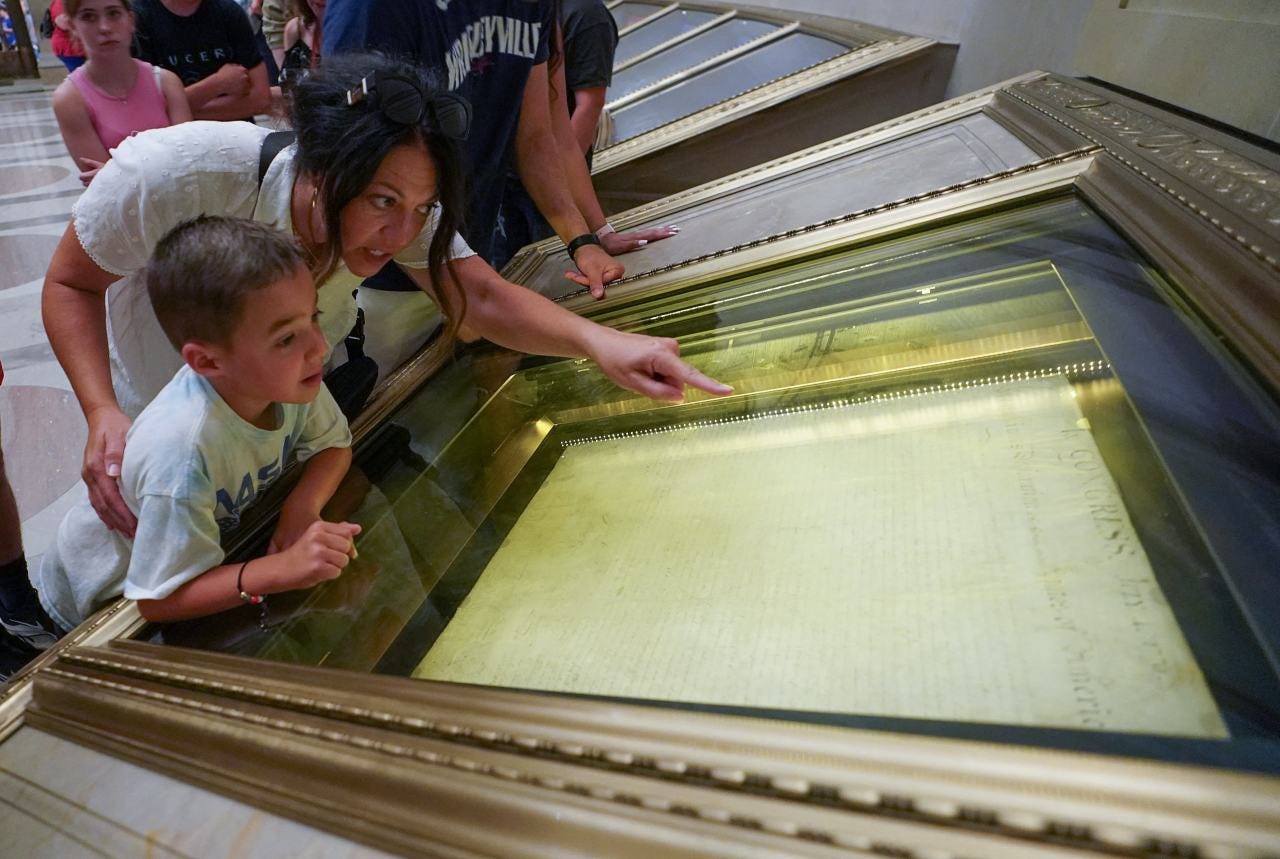
The founding document helps set the parameters of American political life.

Free Expression is a daily newsletter on American life, politics and culture from the Opinion pages of The Wall Street Journal. Sign up and start reading Free Expression today.
We lucked out 100 years ago. In 1926, the U.S. had President Calvin Coolidge as national emcee of that year’s sesquicentennial celebrations. It might sound strange to say that having a man known as “Silent Cal” in the White House then was fortunate. But in those pre-New Deal days, the president wasn’t omnipresent. This suited Coolidge well. When he spoke, it mattered, and it meant something.
The taciturn Coolidge never mattered or meant more than when he spoke in Philadelphia on July 5 of that year. On the day after the country’s birthday (and his), he captured better than any president since Abraham Lincoln what the Declaration of Independence meant. Returning to his words this semiquincentennial can help ensure the U.S. makes it to the tricentennial.
Coolidge understood that nations rise and fall. So the founding of a new nation wasn’t what made the Fourth of July special. Rather, the Declaration’s proposal “to establish a nation on new principles” was what made the first Fourth “one of the greatest days in history.” The singular nature of those principles defies those who contend they’re no longer relevant or don’t transcend their particular context. “If all men are created equal, that is final,” Coolidge said. “If they are endowed with inalienable rights, that is final. If governments derive their just powers from the consent of the governed, that is final.” There’s no “progress” beyond these ideals. There’s only falling short of them.
The then-president may have had too much class to name those he was speaking about. A century later, we needn’t be so restrained. Progressives in that era sought to erode America’s attachment to its founding doctrines. One of them, Woodrow Wilson, had been president shortly before Coolidge, following an academic career devoted to that erosion.
Wilson couldn’t have been clearer in his opposition to what Coolidge believed. A decade earlier, he complained that “some citizens of this country have never got beyond the Declaration of Independence.” This despite the fact that, in his view, the document “did not mention the questions of our day.” To understand what he called “the real Declaration of Independence, do not repeat the preface”—that is, the statement of principles with which it begins. Wilson practiced what he preached. He saw his presidency as a weapon against the American constitutional order, which he viewed as an anachronism of a time when men failed to realize that “government is not a machine, but a living thing”—requiring expansion, of course.
This stark choice between whether the Declaration does or doesn’t matter has defined America. It did so before Coolidge and Wilson. Alexander Stephens, vice president of the Confederacy, declared the founding ideals “fundamentally wrong.” Lincoln honored those who believed them for having created a nation “dedicated to the proposition that all men are created equal.” The choice defines America now. The Declaration should help set the parameters of American political life.
The inheritance of the Declaration ought to be every American’s. But an increasing number of Americans find one way or another to follow Wilson in denying the Declaration’s transcendence. Some find it a hypocritical document produced by hypocritical people, who professed equality while tolerating or endorsing hierarchy and slavery. Others would limit its salience only to those who trace a direct genetic connection to the Founders.
Still others, especially the young, are ignorant of its meaning. As Free Expression columnist Matthew Continetti noted, 35% of baby boomers in a survey by the American Enterprise Institute had read the whole Declaration while less than a quarter of Gen Zers had, and 91% of baby boomers could explain the meaning of the Fourth of July compared to only 77% of Gen Zers. Antipathy, misunderstanding and ignorance are all worrying trends.
Commitment to the Declaration of Independence doesn’t mean complete agreement. Americans have been debating what the document means and how to fulfill the ideals it outlines since July 4, 1776. But without a shared framework, we’ll be lost as a people. And our nation’s luck will run out well before we get to 300.
Mr. Butler is deputy editor of Free Expression.