

Politicians Aren’t Our Friends
But in an age of parasocial relationships, they can seem like they are.

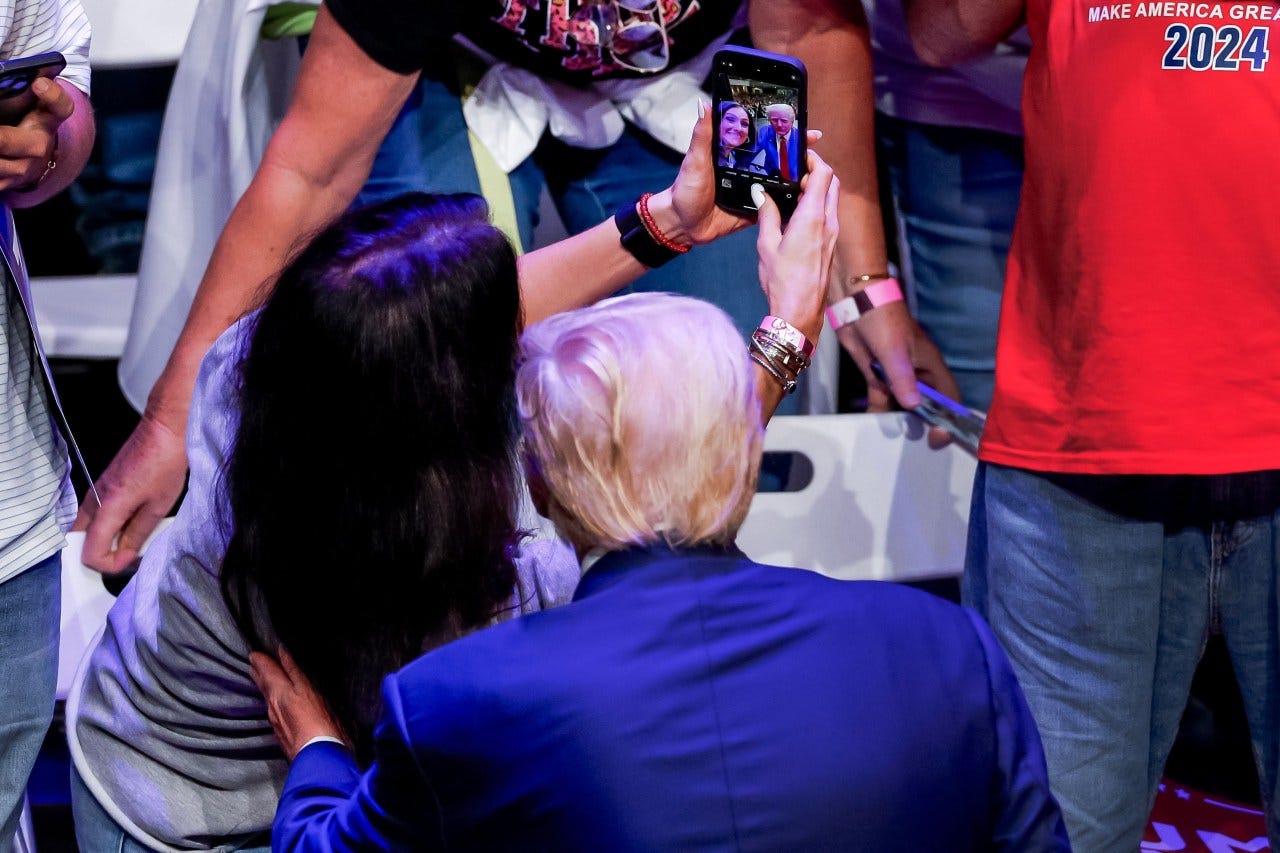
It occurred to me recently that I see President Trump’s face far more often than the face of my next-door neighbor. Not in person, in my case. The Mr. Trump I see is on a screen, or sometimes a piece of paper. But I could nonetheless close my eyes and sketch every contour of his face.
It helps, of course, that Mr. Trump is distinctive in so many ways: distinctive hair, distinctive voice, distinctive skin tone. His image is so memorable that it could almost have been designed by a committee of political advisers to burrow its way into our brains.
When we look at pictures of Mr. Trump’s face, our brains register it as real. When we look at his face multiple times a day, every day, we can all too easily come unconsciously to believe that we have an actual relationship with this person, even though the vast majority of us have never met him in the flesh.
This is the essence of the “parasocial” relationship—that is, a one-sided emotional connection that conveys a false sense of friendship or intimacy. The term was coined in a 1956 paper by the sociologists Donald Horton and Richard Wohl. Writing in the early days of television, they suggested that this machine offered the potential for a new kind of relationship because TV stars engaged so intimately with the audience at home:
Sometimes the ‘actor’—whether he is playing himself or performing in a fictional role—is seen engaged with others; but often he faces the spectator, uses the mode of direct address, talks as if he were conversing personally and privately.
Of course, the “actor”—or, perhaps, the politician—isn’t actually speaking to the audience, as a theater actor on stage would. He is talking to a camera lens. But viewers at home get the impression that they are being addressed directly. In the age of the smartphone, these interactions are far more common. I pick up my phone, open the WSJ app, and there is Mr. Trump, looking right at me.
Mr. Trump is a politician perfectly suited to the age of the screen. His national celebrity career was launched on television, via “The Apprentice,” as well as cameos on “The Fresh Prince of Bel-Air” and other media. In a 2025 paper, political scientists Eunji Kim and Shawn Patterson Jr. found that voters who had seen “The Apprentice” were more likely to vote for Mr. Trump in the 2016 Republican primary, likely because 11 years spent playing the role of “America’s boss” cultivated a parasocial relationship with viewers.
But it was during the digital age that Mr. Trump’s political career came to fruition. Few politicians are as comfortable with the camera lens, nor as adept at generating short-form video clips that circulate on social media. Even his fiercest critics concede that he is charismatic. He speaks casually and irreverently, frequently addressing the public in direct terms. He has an unusual talent for conveying authenticity on screen. It is for this reason that Mr. Trump appears to inspire unusually strong parasocial relationships, both positive and negative. What is “Trump Derangement Syndrome” if not a severe kind of negative parasocial relationship? In this case Mr. Trump plays the role, not of a friend, but of a hated personal enemy whose antics you can’t look away from.
Other politicians are trying to play the same game. The rise of social media, podcasts, livestreams and long-form interviews has made it much easier for them to cultivate the kind of emotional intimacy once accessible only to TV stars. I open up Alexandria Ocasio-Cortez’s TikTok account and the first clip is of her speaking directly to the camera in a video that appears to have been filmed on her phone. She’s wearing sweats and minimal makeup and is zoomed right in. Her tone is casual and intimate because AOC knows exactly what she’s doing: She wants me to form a parasocial relationship with her. She is trying to trick me into thinking she’s my friend.
Compare this with how people of the past interacted with their politicians—that is, hardly at all. You might have seen a speech delivered, probably at a distance. You might once have briefly met your local representative. Once print media arrived, you might regularly see their images. Once radio arrived, you might regularly hear their voices. For most of the history of the United States, an ordinary person might have a strong opinion about a president’s decision-making, but she would have no sense of his personality. In the centuries before photography came along, she might not even be able to pick him out of a lineup.
We can read the history of politics as a gradual advance of technologies that make parasocial relationships possible. This advance has not been good for the quality of governance. I say this not because I particularly oppose Mr. Trump, but rather because I object to this particular style of doing politics. Parasocial relationships are a kind of trickery, intentionally or not. They bewitch and bewilder. A politician’s ability to create an illusion of friendship is no indication of an ability to govern. Nevertheless, as long as our screens and our minds are filled with the faces of people we have never met, the parasocial mode of politics will endure.
Ms. Perry is a Free Expression columnist at WSJ Opinion.
 | A guest post by
|
I wonder about the great statesman of the past, how they would have come across. We're told that Lincoln and Teddy Roosevelt both had high-pitched voices. However, their speeches were said to be highly motivating in person as well as in print. Lincoln's opponent, Douglas, was said to be a great orator, but cold up close. In person, Lincoln was apparently quite magnetic, telling joke after joke, some of which came across in his debates with the "Little Giant." Personal family tradition is that one of my ancestors, a Knox County farmer of Pennsylvania Dutch ancestry, was friends with Honest Abe, and met him at the train station in Galesburg, accompanying him to the stage at Knox College for one of the debates.
We're also told that Frederic Douglass and Lincoln, to the surprise of both men, grew not only in respect for one another, but friendship (one of the auxiliary tragedies of the latter's assassination). I suspect this second-greatest President would have come across quite well, especially with that fashionable beard (suggested by a young influencer) and earthy humor.
Awesome Louise, it is true I/we feel like we know Donald Trump, for instance when he got shot that's when I decided to vote for him again.