

Q&A: Karin Lips
The founder of a conservative women’s forum is on a mission to provide an alternate voice on college campuses.


Polls show that young women are more liberal than they’ve been in decades. But that isn’t the full picture. The Network of Enlightened Women works on dozens of U.S. college campuses to amplify the voices of conservative young women who are questioning progressive orthodoxies. Free Expression associate editor Mary Julia Koch spoke recently with Karin Lips, the founder and president of NeW, about her mission to support conservative women in college and in their careers, and how she’s pushing back on the left’s definition of feminism.
Mary Julia Koch: Why did you decide to found NeW in 2004, while you were a student at the University of Virginia?
Karin Lips: During college, I interned for Sen. Lugar from my home state of Indiana in D.C. I loved being surrounded by women who wanted to talk about how policies and legislation would impact their lives, not just throw out traditional Republican and Democrat one-liners.
I went back to UVA and sought that type of environment among women. I even went to our Women’s Center and scheduled a tour with one of the faculty members there. I could tell that the programs were more leftist, but it’s called the Women’s Center, and we’re a state-funded university, so I asked at the end if they might be interested in co-sponsoring a group for conservative young women. The staff member chuckled and said, “Not here.”
That was very frustrating. But I thought, “I bet there are more women who feel like I do.” So I decided to start a book club at UVA for conservative and more open-minded women. I wanted to talk about people and ideas that weren’t necessarily on college syllabi.
What are the topics that the women you work with are passionate about right now?
One issue that was not an issue 20 years ago is women in sports. Riley Gaines has been a popular speaker for us the last two years. We’ve had her on approximately 20 campuses, including at Harvard where we had a very successful event and reached students outside the conservative community there.
Over the years of the organization, free speech has been a hot topic. It’s shown up in the classroom—being worried about professors’ censorship and bias. Right now, we’re seeing it show up more among students, which I find deeply concerning. At a few schools where students are on the governing committee for deciding what organizations get recognized, we’ve had a number of chapters that have faced increased obstacles to being recognized, most recently, at Texas Lutheran. When you get recognized, you get access to sometimes student funding and classroom space. So it’s almost as if the students are now becoming the censors on campus, which I think is deeply concerning for the future of our country.
What is it like being a young conservative woman on a college campus? Do your students speak about experiencing backlash or alienation?
Our students do face backlash. One student told me about how she lost her childhood best friend after posting something conservative to social media, and many others have faced ridicule for their posts. Others have faced social ostracization in their sororities.
A lot of it is cultural. When I wrote our first book in 2018, “She’s Conservative: Stories of Trials and Triumphs on America’s College Campuses,” one of the themes that emerged was that a number of our students had felt enough peer pressure that they decided to keep their views quiet before they even stepped foot on campus. That’s not only bad for them because they’re not in a place where they feel comfortable speaking up and developing those views. It’s also bad for liberals on campus because then they won’t get to know people who think differently.
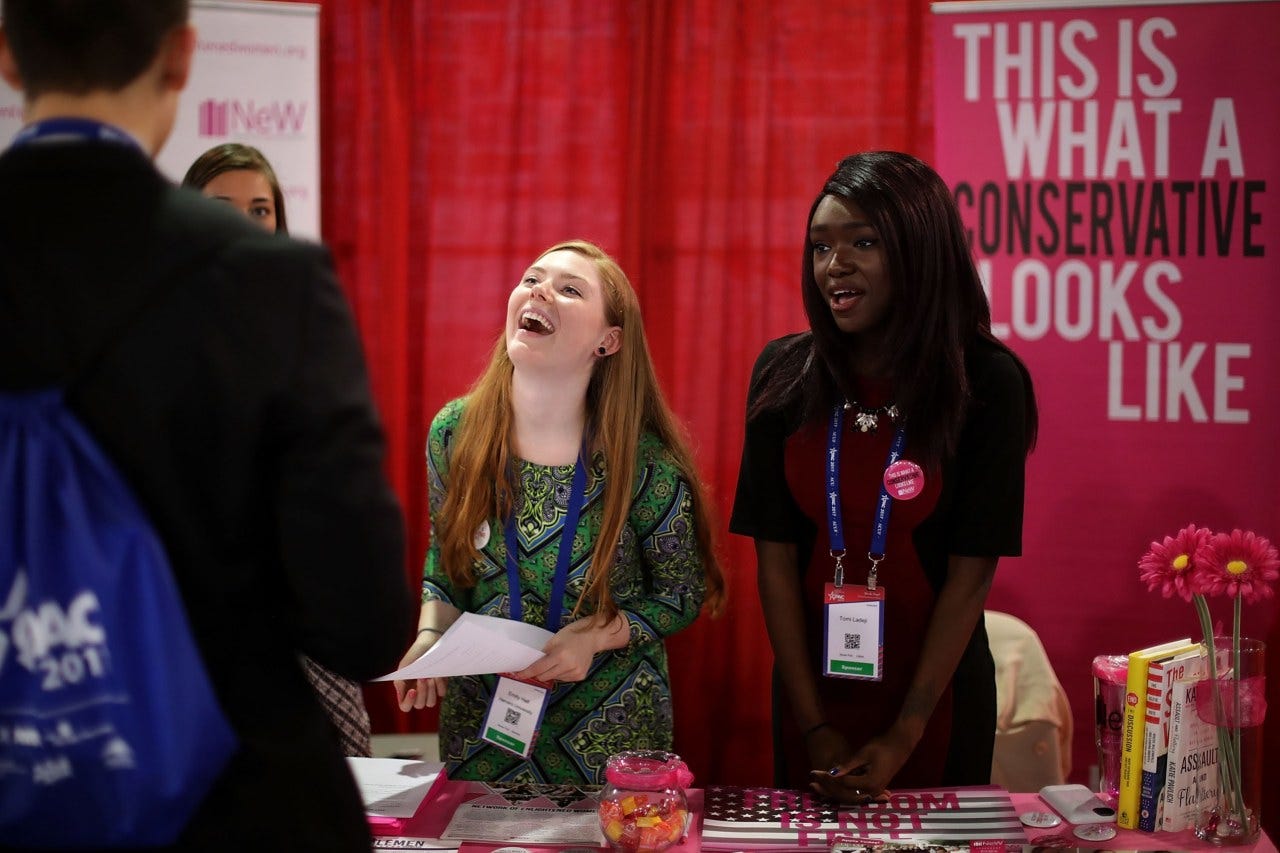
There are different factions within the conservative female movement today: social libertarians, religious conservatives, working mothers and “trad wife” influencers. How do you reconcile all those different ways of being a young conservative woman in 2025?
I very much believe in the idea of seasons. Women might want different things in different seasons, and that’s OK. They might be really focused on careers in one season. They might turn to being a little less focused on careers when they have kids. From the early years when I started the organization, I think there were also different visions. I just think it’s magnified now with social media.
As a mom of young children, what I think is missing in this discussion is that actually a lot of moms would prefer some type of part-time work. In our economy, there’s this idea of full-time, nine-to-five jobs or stay-at-home moms. But I’ve been advocating for more policies and discussion around what I would call the messy middle. Research from the Institute of Family Studies shows that 42% of mothers with young children would prefer full-time work, 39% would prefer part-time and 19% would prefer not to work. There’s this messy middle in there. That includes things like independent contracting work. Maybe it wouldn’t be quite as neat and clean as the girl boss or the trad wife approaches would have you believe, but I actually think it’s where a lot of young women would want to be. Part of our work is helping young women think through these questions honestly, without the ideological messaging that dominates social media.
A recent Pew survey found a 22-point drop over the past 30 years in 12th-grade girls saying that they want to get married. Is there a world in which women can have both a rewarding professional career and a traditional family life?
I think the antimotherhood messaging coming out of the left is very harmful for women and for our country. There certainly are challenges in motherhood, but I think we need a more realistic message about it. This year I had a friend who had her first baby, and she said to me that it was actually easier than she thought it would be because she had seen so much negativity on Instagram about it. To me, that’s a huge red flag if society is sending a message to women in their 20s and early 30s that is really antimotherhood. The problem is not going to be fixed out of Washington. We need leaders to speak up and to call out the people that are too negative and to highlight the good parts of motherhood.
The concept of feminism is viewed differently depending on who you ask across the political spectrum. How would you define it?
Feminism has become a word that’s been co-opted largely by the left. The best example of this is the Women’s March. The left used women to try to advance all kinds of progressive causes.
I want to advocate for a brand of feminism called opportunity feminism, which is grounded in agency and freedom rather than partisan identity. One of the biggest failures of modern feminism is that there seems to be a monolithic view of what women want. And if you don’t march in lock step, then you’re insulted or you don’t count as a woman. Opportunity feminism holds as a basic tenet that women are going to want different things, so let’s try to maximize freedom so that everybody can build the fulfilling life that they want.
Trump’s return to the White House has represented a vibe shift in American culture against woke ideology. Do you think that this cultural shift is improving the climate for young conservative women today?
On the one hand, I think some women now do feel more comfortable speaking out as conservatives after the 2024 election. However, the larger surveys that we see do show this trend of younger men turning a little more to the right, younger women turning a little more to the left.
My own experience confirms that there is a special kind of vitriol reserved for conservative young women. A conservative young woman and a conservative young man could say the same thing, but the reaction from the left is so much harsher on the woman. There’s still this sort of gender traitor vibe promoted by the left that’s harmful. I want to dispel this myth. And that goes back to opportunity feminism. Not all women need to think the same. If you think differently, you shouldn’t be considered a gender traitor by the left.
Ms. Koch is associate editor of Free Expression.
 | A guest post by
|