

Remote Work Lets Moms ‘Have It All’
It doesn’t eliminate trade-offs, but it improves the economics of child care and household management while sustaining career ambition.
Free Expression is a daily newsletter on American life, politics and culture from the Opinion pages of The Wall Street Journal. Sign up and start reading Free Expression today.
A phrase that deserves retirement, along with “geriatric pregnancy,” is the “motherhood penalty.” The reduction in earnings after having children is the product of decisions—to work fewer hours, perhaps in a less punishing job, and spend more time with the baby. For nearly all women, the relationship capital—and the opportunity to do something fundamental to the human experience—will be worth far more than the marginal earnings.
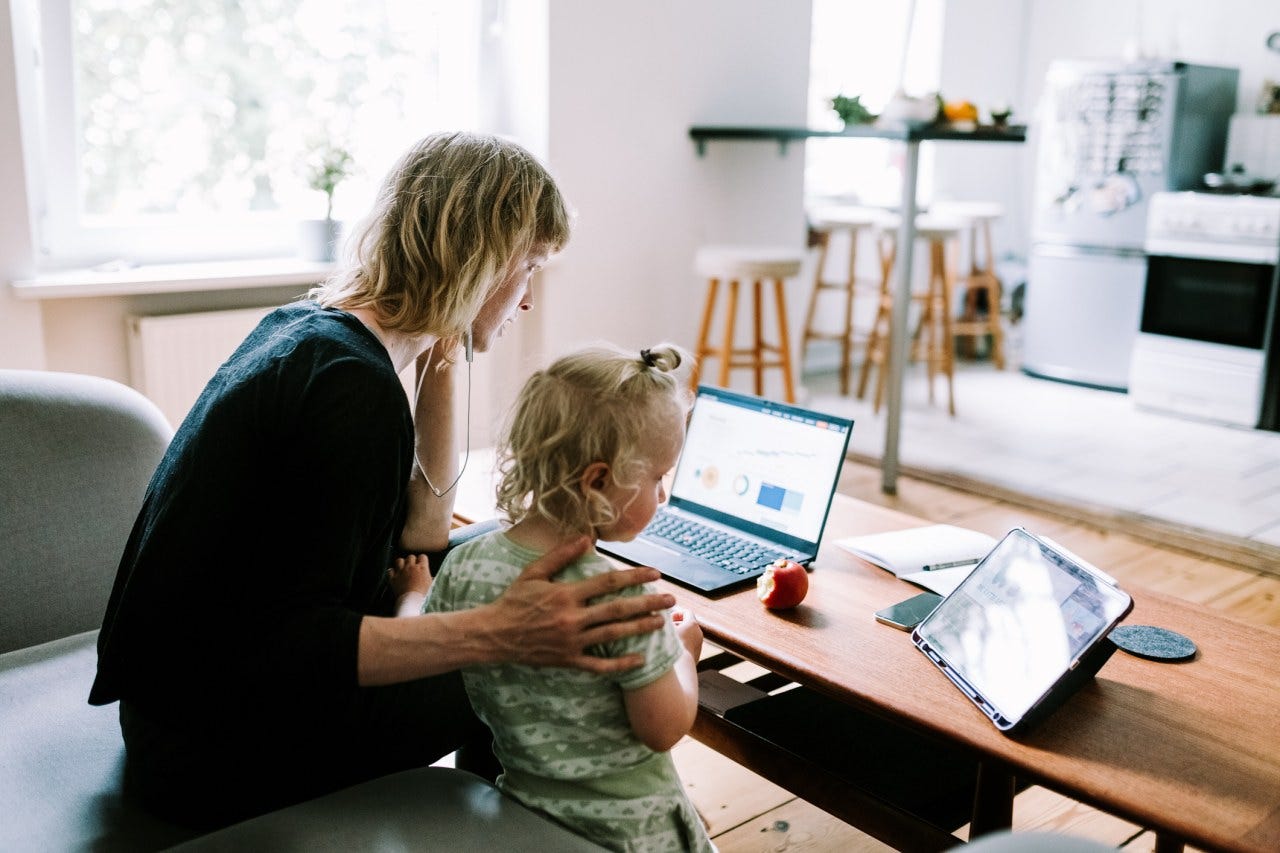
Remote work is the biggest innovation for ambitious women with children since the dishwasher. Over the past six years, it has blunted the traditional trade-off between paid labor and family, and accomplished more than trillions of dollars in government daycare or paid leave could. And it has done all this at zero cost to the public fisc.
Yet a preoccupation with whether women are promoted as much as men in the office is obscuring what should be celebrated as progress. A study from Italy last month found that remote work wiped out much of a woman’s earnings losses after having a child. A flexible work arrangement “substantially reduces mothers’ post-childbirth earning losses, primarily through higher weeks worked, lower part-time incidence, lower parental leave take-up, and improved career progression.”
Not every job can be performed at home. Remote arrangements are concentrated among women with credentials and earning power, though this is also the core demographic that has lamented life’s trade-offs in glossy magazines for decades. Remote opportunities are down from their pandemic highs and employers have tried to corral folks back to the office.
But many employers have more or less set down the butterfly net. “Work from home levels have stabilized since 2023,” reported a Stanford analysis last year. Gallup’s tracker of employees in “remote-capable” jobs also shows a durable use of hybrid and exclusively remote schedules.
Remote work isn’t cost-free. It may make collaboration more difficult and inhibit institutional culture-building. It surely hurts entry-level workers, who learn by absorbing the habits of more experienced mentors and colleagues. There’s evidence that remote staff work less on Fridays than do their counterparts in an office.
Remote work is a perk—a form of compensation, and one women want. Some 40% of workers surveyed for a Harvard Business School working paper said they’d accept a pay cut of 5% or more to retain flexibility. Women were much more likely than men to put 20% of pay on the table to telework. A survey of 2,500 from FlexJobs found women rated flexibility at work as the most important job criterion, ahead of “salary, health insurance, company reputation, and retirement benefits.”
But instead of celebrating wise priorities freely decided, some now worry that hybrid arrangements entrench “a women’s work ghetto.” A 2025 LeanIn.Org and McKinsey report warned of a “flexibility stigma.” And uh-oh: Women who work remotely were “far less likely to have been promoted in the last two years than women who work mostly on-site.”
Concede that there’s a caricature of mothers working at home—too overwhelmed by the screaming kids to accomplish much. But remote work allows women to contribute their skills, earn money and be a primary influence on their children. Ask any mother who works from home: What amount of wages would’ve been worth being at your desk when your daughter took her first steps? It’s going to be a high number. The corner office is for someone who wants to sit in it.
Which brings us to the children, who benefit most from the remote-work revolution. Mothers of young children “who worked full-time from home spent 2.4 additional hours with their children on a given workday compared to those who worked full-time outside the home,” according to an analysis last year by the Institute for Family Studies. Between 2019 and 2023, IFS estimates, nearly a million moms moved from working mostly outside the home to working mostly at home.
Remote work can vastly improve the economics of child care and household management without reducing bandwidth for work. Being at home means less need for daycare, which most women prefer not to use, and more hours of care from a college girl babysitting or a relative. Not being in traffic at 5 p.m. on weekdays radically changes the meals you have time to prepare and serve during the children’s dinner hour.
Working remote or hybrid has trade-offs, as does every choice on the planet. You have to work harder to develop relationships with colleagues. You won’t be at the happy hour. The laptop is on late at night and before dawn. There are few boundaries between work and grocery orders and it all can converge into a twilight of tasks. It isn’t for everyone.
A singularly bad idea is enshrining “a right to remote work,” which would blunt a woman’s leverage to negotiate flexibility. Yet the expansion of remote work also counsels against a “universal” daycare benefit now in vogue among Democrats. The far better approach is to focus government child-care assistance on those lower down the income ladder, as the current welfare state already does. The message also matters at the individual level. Young women who absorb the warnings about “ghettos” are being misled about great openings to do meaningful work and still hang around the kids.
The demands of work and children will always be high. But the core reality is that today’s opportunities to blend work and family would be unrecognizable to a young career woman in shoulder pads in the 1980s. “You don’t have to make the hard decision to just completely stop working” when children arrive and “jump back in when you feel like you’re now behind,” as Rachel Greszler, an economist at Advancing American Freedom, puts it.
“There was a June 2020 New York Times article that was titled ‘Pandemic Could Scar a Generation of Working Mothers,’ ” Ms. Greszler reminds me. Yet that isn’t what happened. The pandemic, she says, “has boosted a generation of working mothers” by creating “new opportunities that weren’t there and weren’t the norm.”
Mrs. Odell is a member of the Journal’s editorial board.
Yes! I WFH and my husband and I both work 4 day weeks and these 2 things are a total game changer for family life. My toddler still goes to daycare on my work days, but I can get lots of little household tasks done during the work week and keep her home when she’s sick. the sickness issue alone—I don’t know how people deal with this if both spouses are on the job.
Working from home only works for roles that can be performed digitally on a laptop. Worth keeping this in mind!