

Screen Time, Tech Addiction and ‘Toy Story’
The latest installment of the Pixar film series casts a tablet as the villain. Until it becomes the hero.

By Emma Camp
Free Expression is a daily newsletter on American life, politics and culture from the Opinion pages of The Wall Street Journal. Sign up and start reading Free Expression today.
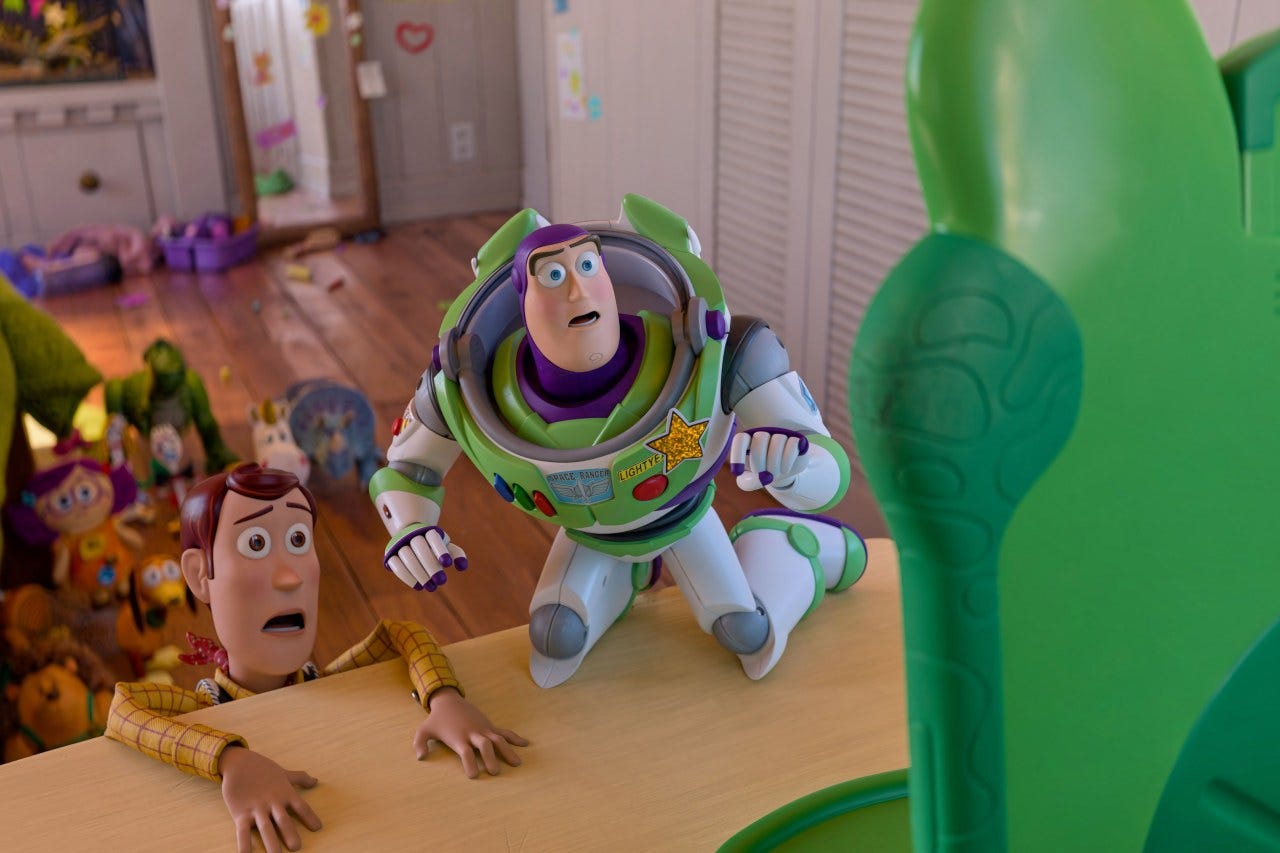
I saw “Toy Story 5” on a whim. The film is chiefly about the evils of screen time—the villain is a chipper, frog-shaped tablet that quickly saps her 8-year-old owner’s will to play with physical toys. Partway through the movie, though, I noticed something astonishing. Sitting in front of me in the theater was a toddler, scrolling YouTube on an iPad. Instead of watching the movie on the big screen in front of her, she paid rapt attention to the much smaller screen in her lap.
I was gobsmacked, though I suppose I shouldn’t have been. Forty percent of toddlers have their own tablets by age 2. One preschool teacher told the Atlantic’s Rose Horowitch that, while students used to cry for their mothers during the first few weeks of school, a little girl she’d recently taught “would cry for her tablet.” We all know that it isn’t only kids who are addicted to screens. Adults’ attention spans waned over the past few decades, and a recent survey found the average American picks up his phone more than 180 times a day. I grudgingly admit that I struggle to watch TV without reaching for my phone.
“Toy Story 5,” despite its framing, tries to make peace with the devices that clamor constantly for our attention. The tablet—called Lilypad—spends much of the film as an unalloyed villain. The moment painfully shy Bonnie gets her tablet, she stops being an imaginative little girl and starts being a screen-obsessed zombie. While she once acted out elaborate fantasy scenes with her toys, she becomes singularly obsessed with the tablet, even after girls from her dance class begin bullying her in an online group chat. Bonnie isn’t the only kid who’s been sucked into the digital world. At one point, the cowgirl doll Jessie discovers that every child in the neighborhood has abandoned toys for devices.
The vision of modern childhood the film presents is borderline apocalyptic: Parents are giving Gen Alpha attention-sucking devices that render children passive consumers of vapid media. As a resigned Woody tells Jessie, “Toys are for play. Tech is for everything.”
Yet the film can’t quite commit to Luddism. Lily retreats into a donation bin when she realizes all the harm she’s done to Bonnie. The other toys, though, have been trying to connect Bonnie with a similarly imaginative little girl named Blaze. They realize the only way to get the pair to meet is to have Lily send Blaze a message impersonating Bonnie. In the end, the tablet is credited with helping Bonnie make a friend, and Lily takes her place in the gang of happy toys.
It isn’t exactly a satisfying ending, but it reflects our culture’s approach to social media and tech. We know scrolling on our phones is bad for us. We lament that Gen Alpha is full of zonked-out iPad kids, and wring our hands that no one reads books anymore. And yet, we don’t do much to stop ourselves. We still reach for Instagram while the TV’s on. The dopamine rush is too hard to resist.
“Toy Story 5” might not have ended up as the antitech crusade its trailer promised, but it does reflect the uneasy relationship many of us have with the screens that dominate our lives. We wish we didn’t spend so much time scrolling, but not so much that we actually stop.
Ms. Camp is senior newsletter editor at Free Expression.