

Storytime With Starmer
The U.K. government uses secrecy, misdirection and storytelling to stifle unease about its radical immigration policies.

Free Expression is a daily newsletter on American life, politics and culture from the Opinion pages of The Wall Street Journal. Sign up and start reading Free Expression today.
We are still at the beginning of the summer, and Britain has already seen three outbreaks of race rioting: in the genteel commuter hub of Epsom, in the seaside town of Southampton, and multiple nights of violence last week in several cities. Summer 2025 was also bad. The previous summer was worse. We don’t know how the coming months will play out, but no one is feeling especially optimistic. Perhaps British people will soon forget that a summer of race riots didn’t used to be the norm.
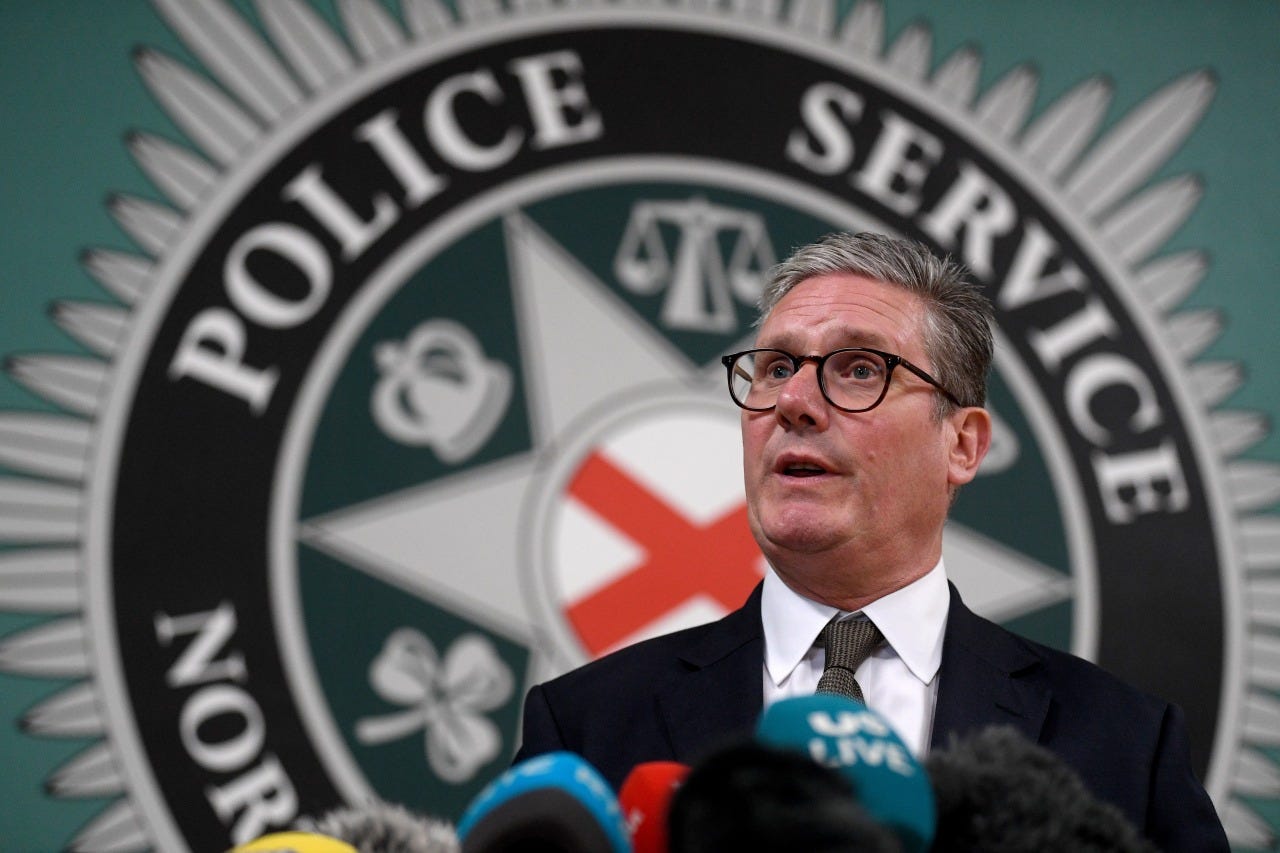
There were some truly awful scenes last week, particularly in Belfast. Vehicles and houses were set alight by mobs of masked men, forcing people to flee their homes. Rioters targeted a hotel being used to accommodate asylum seekers, as well as houses being rented to migrants. This wasn’t random violence directed against police, but something far colder and more strategic. Many have described it as a “pogrom,” and I can’t say I disagree.
Meanwhile, on the British mainland, worshippers at Glasgow’s largest mosque were reportedly locked in for their own safety. A mob in Liverpool damaged an asylum hotel and attacked members of the public and police officers.
The trigger for this latest rioting was a video of an appalling attack that took place in Belfast on June 8. The victim, Stephen Ogilvie, lost his left eye and sustained serious injuries to his head and neck when a Sudanese asylum seeker, Hadi Alodid, allegedly attacked him with a knife, appearing to saw at Mr. Ogilvie’s neck in an attempted decapitation interrupted by brave passersby. The video soon went viral on social media. Within hours angry mobs were in the streets.
While the video of the attack on Mr. Ogilvie was clearly the proximate cause, there is disagreement over the ultimate cause, not only of the rioting in Belfast, but also the unrest that Britain has seen over the past few years.
A popular narrative among progressives is that the blame can be laid at the feet of a small number of bad actors, particularly one unholy trinity: the anti-immigration activist Tommy Robinson; the leader of the Reform Party, Nigel Farage; and the owner of X, Elon Musk. The argument is that anti-immigration statements from these figures serve to inflame popular sentiment, provoking violence from a public that would otherwise be peaceable. Mr. Farage whispers and Belfast burns.
This explanation is in keeping with a longstanding progressive preoccupation with rhetoric and narrative. A popular phrase among Labour insiders betrays this focus: “We need to tell a better story.” The idea is that the public is only angry because it has been told to be angry, and the solution is therefore to tell it something else.
This storytelling responsibility falls in part on the Research, Information and Communications unit, or RICU, a government body tasked by the Home Office with effecting “behavioural and attitudinal change” among the general public. In 2019, it was revealed that the government prepares hashtags, graphics and plans for commemoration events, for instance urgently deploying workers to the site of the 2017 London Bridge attack to paint a mural containing unifying messages about tolerance and solidarity.
But happy murals are no match for the atrocity videos that circulate on social media with increasing frequency, including the attack on Mr. Ogilvie last week. Ministers are reportedly planning to introduce new laws requiring social-media companies to act more quickly to remove inflammatory content during times of rioting, in the hope that this will be enough to prevent future unrest.
Censoring social media might delay the transmission of information, but history shows us that it can’t be prevented. During the period of the French Revolution now described as the Great Fear, rumors spread of an aristocratic plot to starve the French people, provoking hundreds of attacks on chateaux. There have been recent attempts to model the spread of these rumors using epidemiological tools. The Great Fear seems to have travelled about 28 miles every 24 hours along France’s roads, clustering around postal stations as people communicated the rumors by letter, as well as by word-of-mouth.
Agents of the Ancien Regime would have had some grounds to blame the roads, or the postal service, or rising literacy rates for the spread of the Great Fear. These were indeed proximate causes for the spread of “misinformation” (to use an anachronistic term), and therefore the spread of violence.
Social media permits the spread of information at a much faster rate than 28 miles a day. It also permits the spread of images and video, not only words. The naïve hope, therefore, is that silencing the bad actors online will put an end to the British government’s troubles.
The problem is that the British public is being radicalized not by storytelling, but by reality. The country really has undergone demographic change at an extraordinarily fast rate, particularly in major cities, and consistently against the democratic will. When I was born in London in 1992, the city was 71% white British. In 2021, that figure had fallen to 36.8%. “I can think of no other major city,” said Paul Collier, now professor of economics at the University of Oxford, in an interview with the Economist, in which “the indigenous population has more than halved in half a century.” Did officials really expect the public not to notice?
Sometimes the public notices what is going on even when the facts are deliberately concealed. Last year it was revealed that the settlement of thousands of Afghan asylum seekers in Britain had been conducted under conditions of strict secrecy, with a superinjunction in place that forbade journalists, not only to report on what had happened, but even to report on the existence of the injunction. Nevertheless, a briefing paper later circulated among cabinet ministers revealed that rioting hotspots during summer 2024 were largely in places where there was a particular concentration of migrants from the Afghan settlement scheme. The public wasn’t supposed to notice what was going on, and yet it did.
What makes me angry is the recklessness of successive governments who have assumed that secrecy, misdirection and storytelling would be enough to quell any unrest in response to their radical immigration policies.
The origins of this recklessness lie in a distinction between conservatives and progressives identified by the economist Thomas Sowell. Conservatives adopt what Mr. Sowell called the “constrained vision,” understanding human beings to be flawed creatures whose base impulses can sometimes be suppressed, but never eradicated. Progressives, in contrast, prefer the “unconstrained vision,” believing that human nature isn’t only malleable, but perfectible.
According to the unconstrained vision, racism is a habit of thought that can be forgotten with enough education and exposure to diversity. There may be a few people whose bigotry runs so deep that they can never leave it behind, but everyone else is capable, not only of tolerating a multiethnic society, but of enjoying it.
There is some truth to this claim. Today’s Britons—and indeed Americans—are far less openly racist than those of the recent past. In 1958, only 4% of U.S. adults approved of marriages between black and white people; in 2021, the figure was 94%. Since the turn of this century, British people have become far less likely to say that they would object to an immigrant living next door.
Where the unconstrained vision fails is in the scale of its ambition. It is evidently possible to subdue racism or other forms of tribalism. Education surely plays a role in this. A period of sunny economic weather also helps. But it doesn’t seem to be possible to expunge the instinct toward tribalism of some kind, since the tendency to favor the in-group over the out-group appears to be a human universal.
We see this in where people choose to live. Political scientist Eric Kaufmann has found that in both the U.S. and the U.K., white people who oppose immigration are only marginally more likely to move to whiter neighborhoods than those who support it—that is, white progressives self-segregate almost as much as their political opponents do. Students of all backgrounds tend to self-segregate within educational institutions. Tribalism runs deep, even if it’s unconscious.
The constrained vision of human nature directs us to tread carefully here because peace and trust are precious and fragile. I read with sorrow of two Ugandan care workers, Sumayah Nakazibwe and Stella Ariokot, who barricaded themselves into their house in Belfast last week as nearby cars and houses were set alight. Emergency services told them it was too dangerous to attempt to leave and suggested that the women put on their care worker uniforms in the hope of placating any rioters who broke in. They were eventually evacuated with the help of their church pastor.
These women are the blameless victims of decades of misgovernance, and there are many more blameless victims in this country, of every ethnicity. It’s tempting for progressives to pin responsibility on a small number of rabble rousers, because in theory those people could be removed from play and we could return to a Britain in which race rioting wasn’t something that happened every summer. My guess is that the government is set to double down on its favored strategy, offering us “a better story” about where we find ourselves. But the masked men on Britain’s streets are no longer interested in storytime, if they ever were.
Ms. Perry is a Free Expression columnist at WSJ Opinion.
 | A guest post by
|
In all honesty, it's an attestation to the calm and civilty of the British public that after what can be safely considered the greatest peacetime mass ethnic rape in this century, Britain's streets aren't lined with Pashtun tribesmen hanging from lampposts. I'm not in favor of political violence, because you never know how it ends, but I think that what happened in the UK is a crime against humanity, and as a minimum it should bring about practices that disband uncivilized communities, similar to what the Danes have been doing.
I think it’s surprising there aren’t more riots. Maybe there will be and should be after the report on girl rape by Muslims and a blind eye by the police gets out there more.