

The Devil Reads Vogue
If fashion magazines feel irrelevant, it may be because they’ve stopped being fashion magazines.

“Journalism still f— matters!” screams investigative reporter Andy Sachs (Anne Hathaway) after she and her entire team get fired by their local newspaper over text message due to budgetary issues. “Everyone I know is going through this,” one of her colleagues confesses.
This opening scene in “The Devil Wears Prada 2” offers a biting parody of the current state of print media, where the onslaught of the digital age shows no mercy to hard-hitting journalists like Andy. While dressed up in glamor and drenched in nostalgia, the film offers a refreshingly honest portrayal of how much the magazine world has lost its luster since the original film came out in 2006—and how much the industry is clamoring to stay relevant.
Take the obsession with digital metrics. When Andy takes a new job as a features editor of fashion magazine Runway, a stand-in for Vogue, she faces pressure to sacrifice serious journalism for the kind of froth that drives “clicks” online. In one monologue, art director Nigel (Stanley Tucci), details the time and energy required for a high-fashion photoshoot, only to lament how readers scroll past the final image in under a second. The real-world parallel is obvious: As influencers rival legacy media in audience engagement, Vogue increasingly features online personalities like Emma Chamberlain in a bid to stay in the conversation.
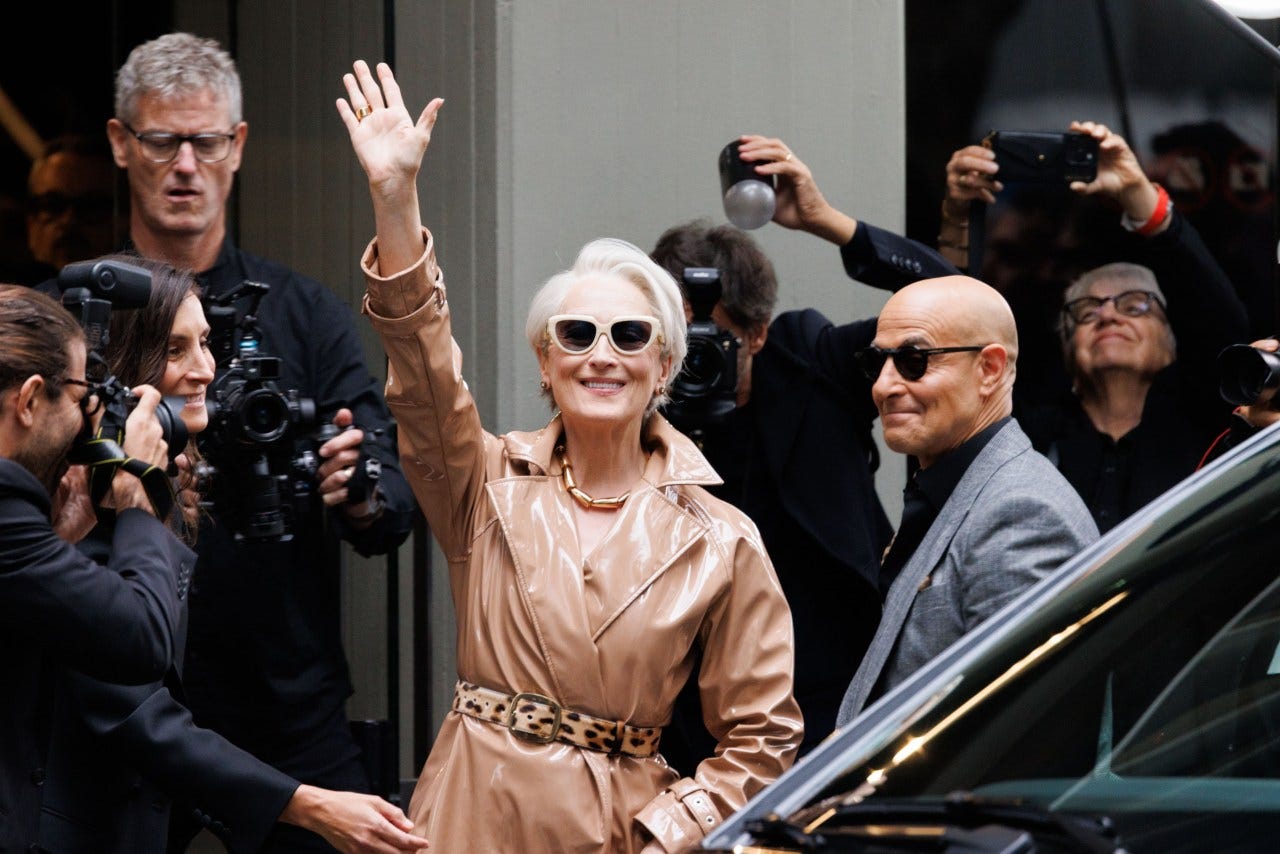
The film also offers a gentle satire of how much office culture has changed in the past 20 years, while avoiding much of the left-coded political preaching common in Hollywood. In the original film, Runway’s editor-in-chief Miranda Priestly (Meryl Streep) was always throwing her coat on her assistant’s desk. Now, she’s seen fumbling to hang up her coat in her office because an assistant complained about the habit to human resources. In one editorial meeting, a Freudian slip causes Miranda to confuse the term “body positivity” with “body negative” while discussing the diversity of models on the runway. She puffs out her cheeks before quipping, with her inimitable iciness, “What is there to be positive about?”
The film’s play on modern corporate speak and Gen Z sensitivities feels especially pointed against the backdrop of a real-life fashion press that has spent the better part of a decade abandoning its lane. Since President Trump’s election in 2016, Vogue has shifted steadily into politics: Kamala Harris graced the cover, Alexandria Ocasio-Cortez filmed makeup tutorials on the magazine’s YouTube channel, and California Gov. Gavin Newsom posed for the February issue. British Vogue recently ran a glowing profile of Francesca Albanese, the U.N.’s special rapporteur for Palestine, despite the U.S. and other nations having called for her resignation over antisemitic bias. These articles might get some clicks, but will they restore magazines to their former glossy glory and prove that, as Andy insists, “journalism still matters”?
“The Devil Wears Prada 2” confirms that today’s magazine world can’t compete with influencers on their own terms. Yet the film’s success—it grossed $233.6 million globally in its opening weekend—proves that fans are craving its cocktail of nostalgia, humor and politics-free escapism, the things you could find in an issue of Vogue in an earlier era. Perhaps there’s a lesson for the real-life Miranda Priestlys: For fashion magazines to survive, they ought to try simply being fashion magazines.
Ms. Koch is assistant editor of Free Expression.
Good summary - more institutions/businesses should stay in their lane and resist the urge to "be relevant" by adopting minority views pushed on Social Media forums that give the appearance of "everybody thinks this" mentality when in fact it is a view not held by a majority, deems others to advance an agenda of some type.