

The Light-Rail Boondoggle
Buses aren’t as cool as trains. But they provide a much better bang for a city’s buck.
By James B. Meigs
Free Expression is a daily newsletter on American life, politics and culture from the Opinion pages of The Wall Street Journal. Sign up and start reading Free Expression today.
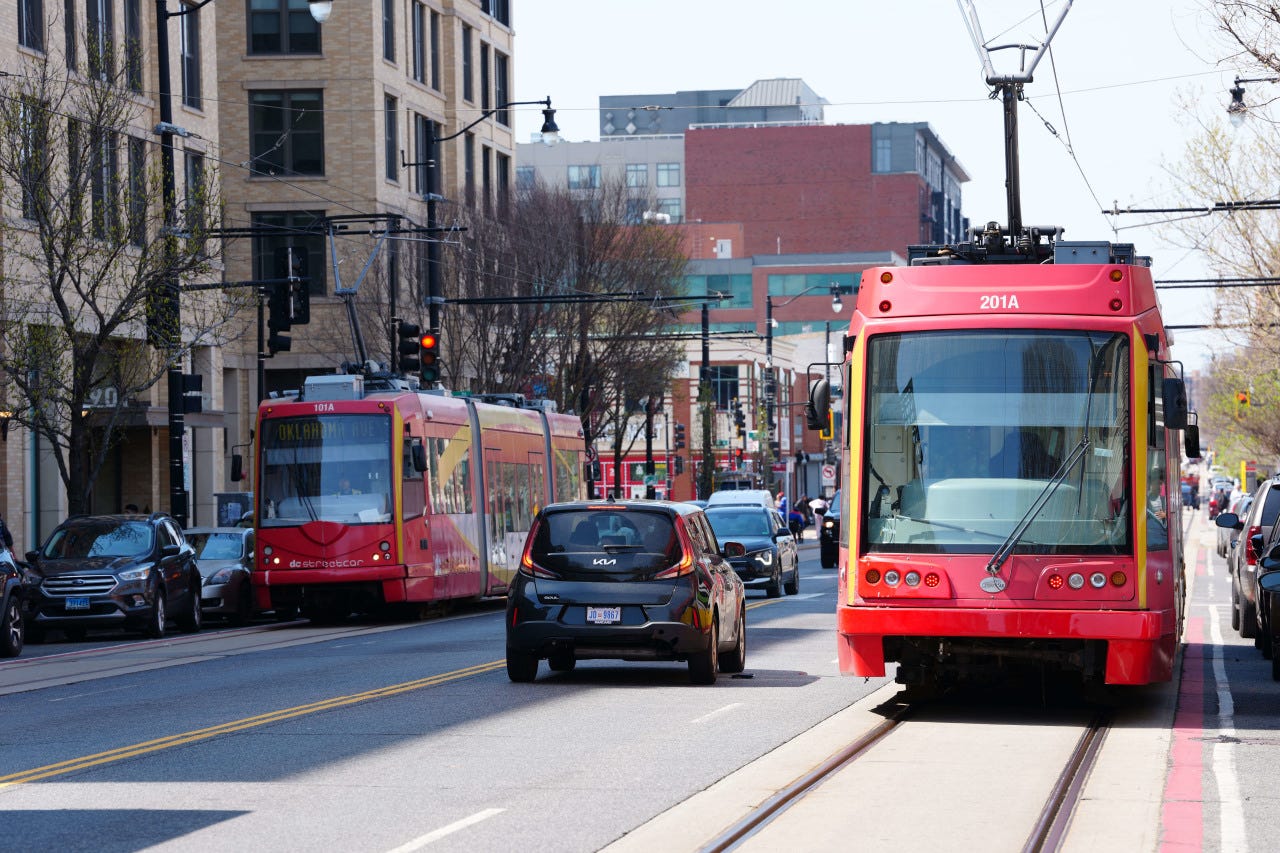
If you’re looking for a good deal on a streetcar, Washington, D.C., has you covered. The cute red conveyances that used to bustle along historic H Street were meant to spearhead “a citywide streetcar revival,” Axios reports. Instead, only two miles of the planned network were ever finished, riders didn’t materialize, and D.C.’s H line became, “the little streetcar that couldn’t.” Now the city has shut down the line and begun auctioning off the streetcars.
In recent decades, many rail-based transit projects have fallen into a similar pattern. City planners propose a convenient network of streetcars, trolleys, or most commonly, higher-capacity light-rail lines. Voters approve. Money gets allocated. And then, like clockwork, construction costs skyrocket, delays pile up and the project gets scaled back. When they do finally open, most light-rail lines fail to attract the promised riders. Nonetheless, political leaders and transit experts keep proposing supposedly visionary rail projects that, history shows, will likely become underutilized money pits.
The backlash comes later. The sprawling Dallas Area Rapid Transit network, for example, serves Dallas and 12 surrounding communities, which levy sales taxes to support the service. But member cities endlessly debate whether DART’s light-rail service is worth the cost, while riders complain about crime and grime. Last month, residents of North Dallas’s Highland Park voted overwhelmingly to leave the system.
In Denver’s historically black Five Points neighborhood, local business leaders are lobbying to have their unpopular light-rail line ripped out. Facing a $35 billion budget shortfall, officials in Seattle are whittling back a massive expansion of that region’s light-rail network. At a final cost of at least $9.8 billion, northern Maryland’s troubled, 16-mile Purple Line wound up costing more than $600 million per mile. Not all transit projects go so far off the—ahem—rails. A few, like Minneapolis’s 12-mile Hiawatha Line, managed to stay on budget and exceed ridership expectations. Still, even that project came in at about $100 million per mile in today’s dollars.
Wise infrastructure planning requires weighing trade-offs. And when it comes to light rail, a much cheaper alternative is always available: Take the bus. A city can add a new bus line on almost any street for the cost of new vehicles, personnel and some signs. More sophisticated Bus Rapid Transit lines—which allow buses to move faster in protected lanes—can be built for about $13 million per mile. Buses can also reach more remote neighborhoods and be rerouted to meet changing needs.
So why do planners and politicians keep clinging to grandiose light-rail schemes? One answer is simple. Trains are cool. They’re sleek and modern. There’s a reason Walt Disney wanted visitors to move around Disneyland on a futuristic monorail rather than boring buses. At the same time, light rail feels reassuringly traditional. To the kinds of people who set transit policy—mostly college-educated professionals—trains and streetcars suggest European sophistication. Who wouldn’t prefer the charming trams of Budapest or Milan? Buses, by contrast, seem humdrum and plebeian. There’s probably a whiff of snobbery in this view as well. Research shows that bus riders are more likely than rail passengers to be lower-income and lack access to a car.
To be honest, I prefer trains, too. I’m lucky to live where I can walk 10 minutes to a commuter rail station and be in New York’s beautiful Grand Central Station 40 minutes later. It’s great. But I understand that New York was able to grow around its century-old subway and commuter rail systems. It’s a lot harder to retrofit rail lines onto newer, less compact cities that—for better or worse—developed around the needs of car owners. Too often, light-rail fans believe they can decree walkable European-style cityscapes simply by forcing rail lines through America’s sprawling neighborhoods.
Some ideas are so appealing that even mountains of evidence won’t change people’s minds. Oxford University economist Bent Flybjerg studies “megaprojects.” In 2022, officials in Ottawa, Canada, asked him to analyze why that city’s $9 billion light-rail project had become a shambolic mess. “If you decide to build rail projects, you have the odds against you,” he told the commission. In more than 80 years of data, he said, only 0.2% of rail projects came in on budget, on schedule and delivered the promised benefits. Even worse, Mr. Flybjerg’s research shows, megaproject backers invariably low-ball costs and overestimate benefits. This results in a kind of inverse Darwinism, “the survival of the unfittest,” he writes. “It is not the best projects that get implemented in this manner, but the projects that look best on paper.”
Politicians have many reasons to ignore warnings like Flybjerg’s. Greenlighting a new bus route might please a few lower-income constituents, but backing a big rail project means front-page headlines and support from contractors and construction unions. Big infrastructure projects also usually attract federal funding. For example, the Federal Transit Administration will pay up to half the $7 billion cost of a light-rail line planned for Austin, Texas. It’s easy to be generous with other people’s money.
In the end though, I think the continued popularity of light rail among policymakers mostly comes down to a vibe. Trains are cool. Buses are practical—and better serve the needs of people who need transit the most—but where’s the magic? Also, perhaps our policy wonks honestly believe that the next futuristic rail project will really deliver on its promises. And if you believe that, Washington, D.C., has a streetcar to sell you. Slightly used.
Mr. Meigs is a Free Expression columnist at WSJ Opinion.
Buses get you where you want to go at a reasonable cost. They can be re-routed as needs change. Lite rail is expensive to build and routes are set in stone. They never made sense once the motorized bus became a reality. Yet the Leftist mind is fascinated by rail travel. It's a 19th century solution to a problem no one had. Since the 1920s we've had buses. Now we have natural gas powered buses. They're clean and quiet. We don't need lite rail. Trains are great for moving large amounts of cargo over land. They suck at moving small numbers of people to jobs that don't exist anymore.
regarding the streetcar line in DC, advocates claimed that economic development would be more successful with rail because biz owners could see the transit improvement was permanent
heh