

You Should Be Able to Fail
What the University of Michigan’s pass/fail decision takes from students.

Good morning. Welcome to Free Expression, a daily newsletter on life, culture and politics from WSJ Opinion.
If someone forwarded you this email, please take a moment to subscribe. You can follow us on X/Twitter, Instagram, Substack and TikTok.
Today in Free Expression, columnist James B. Meigs warns about the dangers at home; Jack Butler tries to get a sense of the DSA hype; and Emma Camp clings to summer.
But first, why you should get a C . . .

Coddle U
—John J. Miller
My first semester was my worst semester.
My grades as a freshman at the University of Michigan weren’t bad, but they weren’t great. I earned a lot of B’s. As a high-school student, I’d gotten a lot of A’s, and I’d gotten them without much effort. I took them for granted.
So that report card from the fall of 1988 delivered important information. It was the academic version of a price signal. It told me that college was different from high school. It also said that if I wanted to do better, I’d have to work harder.
And that’s more or less what happened. My grades improved. I still had struggles. For a Spanish course that required listening to Venezuelan news broadcasts, my girlfriend tutored me in the language lab. (And I became a male Jane Eyre: Reader, I married her.)
By my junior year, however, I had become the king of the A-minus.
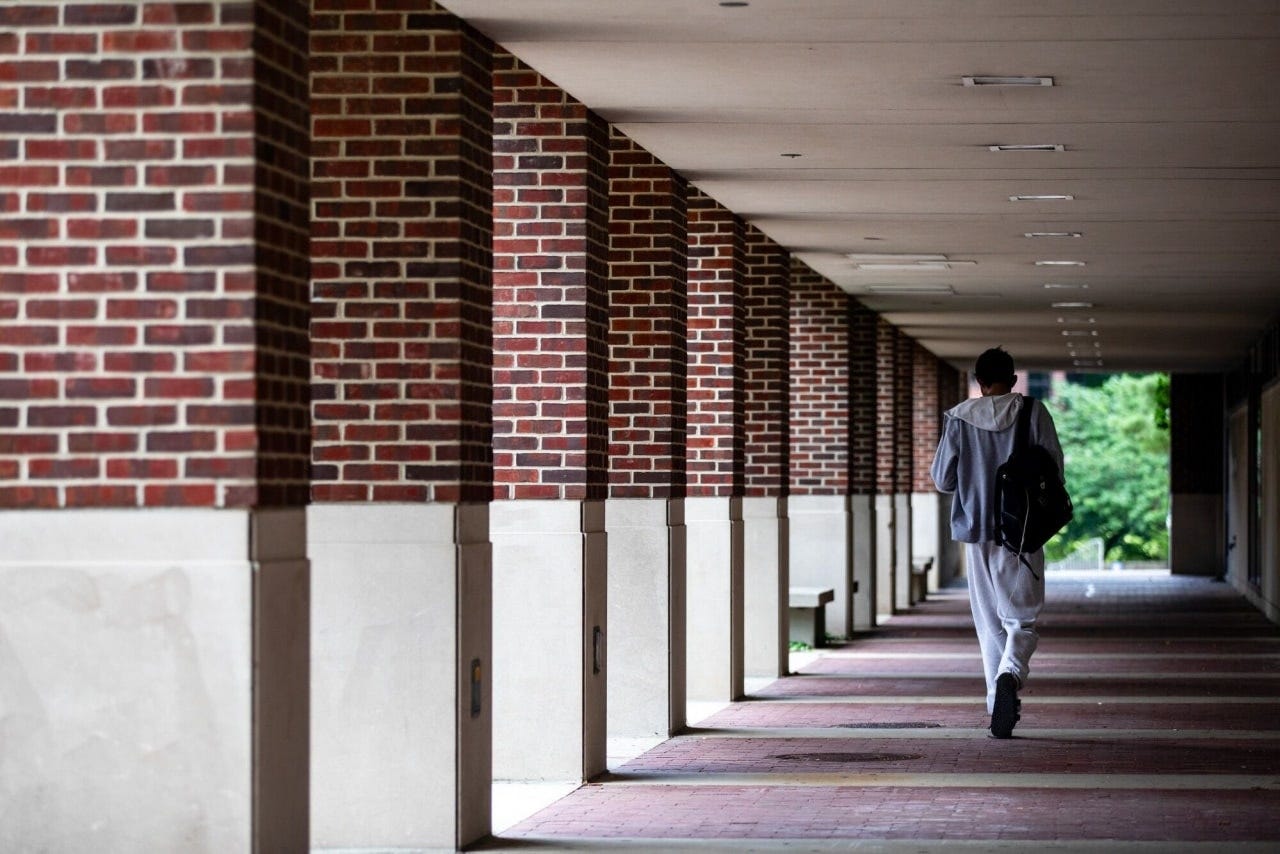
Next year’s freshmen in Ann Arbor won’t receive letter grades. As The Wall Street Journal reported this week, Michigan has announced that starting in the fall of 2027, first-semester freshmen in the College of Literature, Science, and the Arts will forgo A’s, B’s, C’s and so on. Transcripts will record “pass” or “no credit.” This is to “curb the mental health crisis unfolding among college-aged individuals.”
I give this idea an F.
What we have here is a crisis of coddling. College is hard. Or at least it’s supposed to be hard. It should challenge rather than infantilize. It should also help students find ways to rise to the challenge. Grades are a means by which professors can deliver good news, bad news and hard news.
Many colleges and universities have given up on hard grading. They’ve surrendered to grade inflation. In 2012, according to an analysis by the news consortium MLive, 57.6% of undergraduate grades at the University of Michigan were an A-plus, A or A-minus. In 2022, this figure had bloated to 74.1%. It may be worse today. Perhaps this was inevitable in Ann Arbor, where the locals sometimes call their city “A-squared.” Yet Ann Arbor is no trendsetter. The problem is pervasive.
For the last 15 years, I’ve taught writing at Hillsdale College, a 75-minute drive west of Ann Arbor. The most important thing I’ve learned about grades is that they can motivate. Tough grading on early assignments is often a step to achievement. As I like to say when I’m handing back the first batch of papers, “C is for college.” The grades tend to go up as the semester grinds on. They also tend to be deserved rather than received.
If grades go away, the next likely move is to dumb down the content of courses. I don’t know if English professors still assign Lewis Carroll’s “Alice in Wonderland” in Ann Arbor, but I’m reminded of what the Dodo says in that book: “Everybody has won, and all must have prizes.” Instead of diplomas, graduates will have participation trophies.

Turn Around: Yesterday saw the first total solar eclipse in Europe since 1999. The eclipse, which occurred mostly over the Atlantic, also touched parts of Iceland, Greenland and Spain. Some parts of the U.S. also experienced partial solar eclipses, including around a 9% eclipse in New York which took out a tiny sliver of the sun. Eclipse chasers who missed out on this one will have two more chances next year, with one eclipse in southern South America in February 2027 and another spanning North Africa in August 2027. The next total solar eclipse in the U.S. won’t be until 2033, when parts of Alaska will witness the astronomical event. Better bundle up! — Emma Camp
Extrasensory Pet-ception: Dog owners who believe their pets understand how they feel now have scientific backing for thinking so. A study published in the journal iScience placed dogs in MRI machines and measured their neurological responses to pictures of humans displaying a variety of emotions. Pictures of happy humans lit up areas of the dog brain associated with reward. The canine mind even was able to distinguish between anger, fear and sadness expressed by humans. Now if we could only confirm what dogs are dreaming about. — Jack Butler

All Hail Finance Bros: College campuses have earned a reputation for churning out progressive radicals. But the more nuanced story is that students’ politics are strongly correlated to what they study. According to 2026 data from the Foundation for Individual Rights and Expression, the most liberal and Democratic students on campus major in such subjects as environmental studies, public policy, anthropology, English and theater. By far the most Republican and conservative students—yes, they do exist—major in finance. Also clustered on the right-leaning end of this spectrum are accounting, business and marketing majors. Students steeped in economics and the incentives that make our world go round defy the more liberal tendencies of the rest of the student body. No surprise there. —Mary Julia Koch

Not Safe at Home
James B. Meigs
The next war might not start with Chinese troops landing on Taiwan’s beaches or Russian tanks rolling through the Baltics but in your house.
For well over a century, Americans fought wars exclusively overseas. Today, technology is eroding that protective barrier.
Read James’s Column ⧁
Left-Wing Candidates Are Hype Masters

DSA-type candidates have mastered the art of hype. It can cow moderate rivals and “establishment” forces into submission even when it’s overblown.
Don’t Autumn My Summer

Autumn has long been creeping earlier into the cultural calendar. As summers grow hotter and longer, everyone seems all the more eager to bust out the pumpkin spice and start decorating for Halloween as soon as possible.

From Isaac Newton to Jason Arday

How higher education’s capacity for challenging thought deteriorated.
Democrats vs. the AI Ad Machine

California lawmakers are pushing a bill that could target the viral videos behind the rise of Republican candidates in their state.
A Modest Proposal to Deal With Spam Calls

Let people set a price for their time, and let telemarketers decide whether to pay.
By Gary Saul Morson
About Free Expression
Free Expression is a daily newsletter on American life, politics and culture from the Opinion pages of The Wall Street Journal.
Published directly to your inbox Monday through Friday, Free Expression features news and commentary from WSJ Opinion editors, regular columnists and other contributors.
Sign up and start reading Free Expression today.
another excellent issue